What Is the Davis-Stirling Common Interest Development Act?
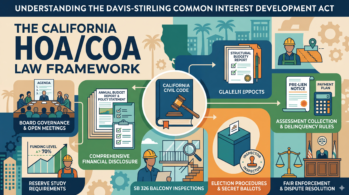
The Davis-Stirling Common Interest Development Act is the primary body of California law governing homeowners associations, condominium associations, and other common interest developments. First enacted in 1985 and significantly reorganized and recodified in 2014, the Davis-Stirling Act is codified in California Civil Code Sections 4000 through 6150 and establishes the legal framework for virtually every aspect of how a California HOA or COA operates.
The Act covers an extraordinarily broad range of association governance topics – from how a board is elected and how meetings must be conducted, to how assessments are collected, how disputes are resolved, and how the association’s finances must be disclosed to homeowners. For California HOA and COA boards, understanding the Davis-Stirling Act is essential. Violations of the Act can expose board members to personal liability, invalidate association actions, and create grounds for expensive litigation.
Unlike Washington’s Uniform Common Interest Ownership Act (WUCIOA), which is relatively modern and streamlined, the Davis-Stirling Act has accumulated decades of amendments, judicial interpretations, and companion legislation – including significant additions like SB 326 (2019), AB 3182 (2020), and AB 1101 (2021). Keeping up with California HOA law takes consistent attention, and most volunteer board members are already stretched thin.
Key Facts About the Davis-Stirling Act
Davis-Stirling Financial Disclosure Requirements
The Davis-Stirling Act imposes some of the most comprehensive HOA financial disclosure requirements in the country. California HOA boards are required to provide homeowners with a detailed annual disclosure package – commonly called the Annual Budget Report and Annual Policy Statement – that covers the association’s financial health, reserve fund status, planned expenditures, and key governance policies.
Annual Budget Report (Civil Code §5300)
The Annual Budget Report must be distributed to all members at least 30 to 90 days before the start of the association’s fiscal year. It must include the operating budget for the upcoming year, a reserve funding summary showing the current reserve balance and the percentage funded, a summary of the reserve study, and the estimated remaining useful life and replacement cost of major reserve components. The report must also disclose whether the board anticipates any special assessments in the coming year and explain the basis for any proposed assessment increases.
The reserve funding disclosure within the Annual Budget Report is one of the most scrutinized elements of California HOA governance – both by homeowners and by lenders and buyers who review it during real estate transactions. An association that is significantly underfunded relative to its reserve study raises immediate red flags for lenders and can directly impact a buyer’s ability to obtain financing for a unit purchase.
Annual Policy Statement (Civil Code §5310)
The Annual Policy Statement must be distributed within 30 to 90 days before the start of the fiscal year and must include the association’s collection and lien policies, enforcement and fine schedule, architectural review procedures, the location where association records are kept, and a summary of the dispute resolution process available to members. Beginning in 2022, the policy statement must also include a statement of the association’s policies regarding electric vehicle charging station installation rights.
Monthly and Annual Financial Statements
California HOAs are required to prepare and make available regular financial statements. For associations with gross revenues over $75,000 per year, a review of the annual financial statements by a licensed CPA is required every other year (unless the members vote to require an audit). Boards must also maintain financial records including ledgers, check registers, bank statements, and invoices for at least five years, and make these records available for member inspection upon request.
Financial Disclosure Checklist for California HOA Boards
Annual Budget Report distributed 30,90 days before fiscal year start
Annual Policy Statement distributed 30,90 days before fiscal year start
Reserve study updated – full study every 3 years, update study in alternate years
CPA review of annual financials (associations with gross revenues over $75,000)
Financial records maintained for minimum 5 years and available for member inspection
Davis-Stirling Assessment Collection and Delinquency Rules
The Davis-Stirling Act establishes a detailed framework for HOA assessment collection and delinquency enforcement that California associations must follow precisely. Deviation from the statutory process – even when collection is clearly justified – can invalidate liens, expose the association to legal challenge, and result in the association bearing the cost of the homeowner’s attorney fees.
Pre-Lien Notice Requirements (Civil Code §5660)
Before recording a delinquency lien, the association must send a pre-lien notice to the delinquent owner at least 30 days before recording the lien. The notice must be delivered by first-class mail and certified mail, include the amount of the delinquency itemized by assessment, late charges, fees, and interest, and inform the owner of their right to request a payment plan and to dispute the debt through the association’s internal dispute resolution process. Failure to deliver proper pre-lien notice is one of the most common errors in California HOA collection enforcement and one of the most common grounds for lien challenges.
Payment Plans (Civil Code §5665)
California HOAs are required to offer delinquent homeowners a payment plan if requested. The payment plan must extend at least three months, and the association’s collection policy must describe the terms under which payment plans will be offered. Many associations are unaware of this obligation, which can create significant legal exposure when collection enforcement is challenged.
Assessment Increases and Special Assessments (Civil Code §5605, §5610)
Under the Davis-Stirling Act, the board may increase regular assessments by up to 20% per year above the previous year’s budget without member approval. Any increase exceeding 20% requires approval by a majority of a quorum of members. Special assessments that in aggregate exceed 5% of the association’s budgeted gross expenses for the fiscal year also require member approval. Boards that exceed these thresholds without proper member approval risk having the assessment invalidated.
Davis-Stirling Reserve Fund Requirements
California HOA reserve fund requirements under the Davis-Stirling Act are among the most comprehensive in the United States. The Act requires every California common interest development association to conduct a reserve study and maintain adequate reserve funding to cover the repair and replacement of major common area components.
Reserve Study Requirements (Civil Code §5550)
California HOAs must conduct a full reserve study – including a visual on-site inspection of all major common area components – at least every three years. In the intervening years, an update to the reserve study (without a new on-site inspection) must be completed. The reserve study must identify all major components with a remaining useful life of 30 years or less, estimate their remaining useful life and replacement cost, and calculate the annual contribution needed to maintain adequate funding. This calculation must be disclosed to members in the Annual Budget Report.
Reserve Funding Adequacy
The Davis-Stirling Act requires associations to annually determine and disclose to members the percentage of fully funded reserves – the ratio of the current reserve balance to the amount that would be in the reserve fund if it were ideally funded for all identified components at their current stage of useful life. While the Act does not mandate a specific minimum funding percentage, it does require disclosure of the current funding level and the association’s plan to achieve and maintain adequate funding. Associations that are less than 70% funded are considered underfunded by most reserve specialists and lenders.
In practice, inadequate reserve funding creates real pressure fast. When major components need replacement and the reserve fund is depleted, the association has two options: a special assessment – which can reach tens of thousands of dollars per unit in a condominium – or an association loan. Both options damage homeowner satisfaction, reduce property values, and reflect poorly on the board’s stewardship.
Board Meeting Requirements Under Davis-Stirling
California HOA board meetings are subject to strict transparency and notice requirements under the Davis-Stirling Act – far more extensive than most states. California boards operate under an “open meeting” standard that is functionally similar to requirements imposed on public agencies, though with certain exceptions for executive session topics.
Meeting Notice Requirements (Civil Code §4920)
Board meeting notices must be posted and distributed at least four days before the meeting. The notice must include the meeting agenda, and the board may generally only act on items included on the posted agenda. Emergency meetings may be called with less notice, but the definition of an emergency is narrow. Homeowners have the right to attend board meetings (with limited exceptions for executive session) and to speak during open forum before the board takes action on any agenda item.
Annual Meeting and Election Requirements
California HOA annual meetings and board elections are governed by extremely detailed procedural requirements under the Davis-Stirling Act and the California Corporations Code. Elections must be conducted by secret ballot using an inspector of elections. Notice of the election must be provided at least 30 days before ballots are distributed, and ballots must be available for counting for at least 30 days. Failure to follow the statutory election procedures precisely is one of the most common grounds for election challenges – and successful election challenges can invalidate an entire board election.
Executive Session
California boards may meet in executive session (without homeowners present) only for specific topics defined by statute – including litigation, contract negotiations, formation of disciplinary proceedings against a member, personnel matters, and a few others. The board must announce that it is going into executive session and the general subject matter. A common mistake is to conduct discussions in executive session that do not fall within the permitted topics – which can expose the board to challenge and liability.
SB 326 – Balcony and Elevated Structure Inspections for California Condominiums
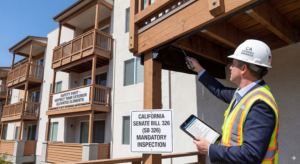
Senate Bill 326 (2019), codified at California Civil Code §5551, is one of the most significant additions to California HOA law in recent years and applies specifically to condominium associations. SB 326 requires condominium associations with three or more units to inspect exterior elevated elements – balconies, decks, stairways, walkways, and their supports and railings – on a regular inspection cycle.
What SB 326 Requires
SB 326 requires that exterior elevated elements be inspected by a licensed structural engineer or architect every nine years. The first round of SB 326 inspections was required to be completed by January 1, 2025 for associations with buildings in existence before 2020. The inspection must visually examine a statistically significant sample of the exterior elevated elements and report on their current condition, whether they are in a generally safe condition, and their expected useful life. If immediate safety hazards are identified, the association is required to take immediate corrective action and notify all residents.
SB 326 Compliance Deadlines
Many California condominium associations are still behind on SB 326, either because they were not aware of the requirement or because inspection scheduling was delayed. Non-compliance exposes boards to significant liability, particularly if a structural failure occurs on an element that should have been inspected. Associations that have not completed their initial SB 326 inspection should prioritize doing so immediately. AmLo coordinates SB 326 inspection scheduling and compliance tracking for all California condominium associations we manage.
SB 326 Quick Reference
Rule Enforcement Under the Davis-Stirling Act
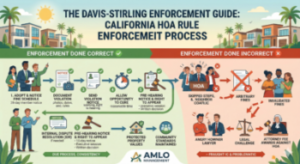
The Davis-Stirling Act establishes specific procedural requirements for how California HOA and COA boards enforce association rules and impose fines and penalties. Failure to follow the required disciplinary process is one of the most common grounds for homeowners to challenge fines and enforcement actions – and successful challenges can result in the association paying the homeowner’s attorney fees.
Pre-Hearing Notice and Right to Appeal (Civil Code §5850)
Before imposing a monetary penalty on a member for a violation of the association’s governing documents, the board must provide the member with written notice of the alleged violation and an opportunity to appear before the board at a hearing at least 10 days after the notice. The member has the right to appear with counsel, present evidence, and respond to the board’s allegations. The board must provide a written decision within 15 days of the hearing. A fine imposed without following this process is generally unenforceable.
Internal Dispute Resolution (Civil Code §5900)
The Davis-Stirling Act requires California HOAs to provide a fair, reasonable, and expeditious procedure for resolving disputes between members and the association. Before filing a civil lawsuit over most disputes, either the association or a member can request internal dispute resolution – an informal conference with a board member and the requesting party. Both parties are entitled to request this process and it must be completed within a reasonable time. Failure to respond to an IDR request can result in the association losing its ability to recover attorney fees.
Working with a Davis-Stirling Compliant HOA Management Company
The Davis-Stirling Act’s comprehensive requirements create a significant ongoing compliance burden for California HOA and COA boards. The financial disclosure obligations alone require careful calendar management, professional-grade financial reporting, and coordination with reserve study specialists and CPAs. Add board meeting procedures, election administration, enforcement protocols, and SB 326 compliance tracking – and the scope of what a California HOA board must manage correctly becomes genuinely demanding for volunteers.
A management company with real Davis-Stirling expertise is more than a convenience – for many California associations, it is the difference between staying compliant and taking on avoidable risk. The right management company does more than process work orders and collect assessments. It understands the statutory calendar, prepares the required annual disclosures, administers elections under proper Civil Code procedures, tracks SB 326 inspection deadlines, manages the delinquency process correctly, and keeps the board informed of upcoming legal obligations.
AmLo Management provides full-service HOA and COA management for communities across Los Angeles and Ventura counties with deep Davis-Stirling compliance expertise. Our Marina del Rey office serves communities throughout the greater Los Angeles area – from Simi Valley and Thousand Oaks to Santa Clarita, Marina del Rey, and surrounding communities.
HOA Management
Full-service Davis-Stirling compliant management for single-family HOAs, townhome communities, and master planned developments across Los Angeles and Ventura counties.
COA Management
Condominium association management with SB 326 compliance coordination, complex capital planning, and Davis-Stirling expertise across Los Angeles and Ventura counties.