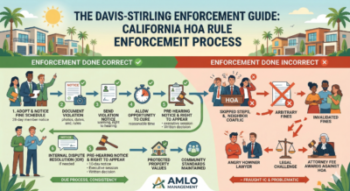
Enforcement is one of the most important — and most legally fraught — things a California HOA board does.
Done correctly, rule enforcement protects property values, maintains community standards, and demonstrates to homeowners that the board takes its governance responsibilities seriously. Done incorrectly, enforcement exposes the association to legal challenge, invalidates fines, generates attorney fee awards against the association, and creates exactly the kind of neighbor-versus-board conflict that makes board service miserable.
The Davis-Stirling Common Interest Development Act establishes a specific procedural framework for HOA rule enforcement in California. It is not optional, it is not flexible, and skipping steps — even when a violation is obvious and the owner is clearly in the wrong — can make the entire enforcement action unenforceable.
This guide walks through the Davis-Stirling enforcement process in detail: the required steps, the common mistakes, and the principles that make enforcement programs fair, consistent, and legally defensible.
The Legal Foundation: What Davis-Stirling Requires for Rule Enforcement
The Davis-Stirling Act’s enforcement framework is built on two foundational principles: due process and consistency. Owners must receive notice of alleged violations and a meaningful opportunity to respond before fines are imposed. And enforcement must be applied consistently — the same rule enforced the same way for all owners, without favoritism or selective application.
These aren’t just aspirational standards. They are legal requirements. Enforcement actions that violate due process can be invalidated by a court. Selective enforcement can expose the association to discrimination claims and attorney fee liability. Understanding and following the required process is not bureaucratic box-checking — it is the difference between enforceable and unenforceable.
Step 1: The Fine Schedule Must Exist and Be Properly Noticed
Before the association can levy a single fine, it must have a properly adopted and noticed fine schedule. This requirement surprises many boards — and many boards that have been fining owners for years discover that their fine schedule was never properly adopted.
Under Civil Code §5850, the association must provide notice of any proposed rule change — including the adoption or amendment of a fine schedule — to all members at least 28 days before the board votes on it. The notice must describe the proposed change in sufficient detail for members to understand what is being changed and why.
This 28-day pre-adoption notice requirement applies to the fine schedule itself. A fine schedule that was adopted without this notice is legally deficient. Fines levied under a deficient fine schedule are unenforceable.
The fine schedule should specify the dollar amount of fines for each type of violation, whether fines escalate for repeat violations, any grace periods before fines begin, and the process for disputing fines. Once properly adopted, the fine schedule must be distributed to all members as part of the annual disclosure package.
If your association doesn’t have a fine schedule that was adopted with proper 28-day notice and distributed to members, fixing this is the first step in building a legally defensible enforcement program.
Step 2: Document the Violation
Before initiating any enforcement action, the association needs documented evidence of the violation. This means more than a neighbor complaint — it means a written record that describes the specific violation, identifies the rule or CC&R provision that was violated, notes the date and time of the observation, and ideally includes photographs.
Documentation matters for two reasons. First, if the enforcement action is later challenged, the association needs a factual record of what it observed and when. A fine that can’t be supported by contemporaneous documentation is vulnerable to challenge. Second, documentation disciplines the enforcement process — it forces the board or management company to identify the specific rule that was violated rather than acting on a vague sense that something is wrong.
Management companies typically handle routine violation documentation as part of their property inspection process. For self-managed associations, the board should establish a clear process for how violations are identified, documented, and reported before any notice is sent.
Step 3: Send the Violation Notice
Once a violation is documented, the association sends a written violation notice to the owner. Under Davis-Stirling, this notice must be sent to the owner’s address of record — not just posted on the property or hand-delivered to a tenant.
The violation notice should clearly identify the specific rule or CC&R provision that was violated, describe what was observed and when, state what corrective action is required, specify the deadline for corrective action, and inform the owner of their right to request a hearing before any fine is imposed.
The notice should not include a fine. The violation notice is a warning and an opportunity to cure — the fine process is separate and comes later, only if the violation is not corrected or recurs.
Tone matters. Violation notices that are accusatory, threatening, or condescending generate more pushback and more disputes than notices that are factual, respectful, and focused on what needs to be corrected. The goal of the initial notice is compliance, not confrontation.
Step 4: Allow a Reasonable Opportunity to Cure
After sending the violation notice, the association must give the owner a reasonable time to correct the violation before initiating the fine process. What constitutes a reasonable cure period depends on the nature of the violation — a few days may be appropriate for a trash bin left at the curb, while several weeks may be appropriate for landscaping that needs to be replanted.
Many associations specify cure periods in their enforcement policy. Having a written policy that specifies standard cure periods by violation type makes enforcement more consistent and more defensible.
If the owner corrects the violation within the cure period, the matter is closed. Document the correction and move on. If the violation is not corrected — or if it recurs after correction — the association proceeds to the hearing process.
Step 5: The Pre-Hearing Notice and Right to Appear
This is the step most boards get wrong, and it is the step that most often invalidates enforcement actions.
Under Civil Code §5855, before imposing a monetary penalty on a member for a violation of the association’s governing documents, the board must provide the member with written notice of the alleged violation and an opportunity to appear before the board at a hearing. The notice must be delivered at least 10 days before the hearing date.
The notice must include the date, time, and location of the hearing; a description of the alleged violation; the proposed penalty amount; and a statement of the member’s right to appear at the hearing with counsel, to present evidence, and to respond to the board’s allegations.
The hearing itself must be held in executive session — it is one of the statutorily permitted topics for executive session under Davis-Stirling. The member appears before the board, presents their side, and the board deliberates privately.
After the hearing, the board must provide the member with a written statement of its decision within 15 days. If the board decides to impose a fine, the written decision must state the amount and the basis for the penalty.
A fine imposed without following this process — without the required 10-day notice, without providing the opportunity to appear, or without the written decision — is generally unenforceable. Courts and arbitrators routinely void fines that were imposed without the required due process.
Step 6: Internal Dispute Resolution
California’s Davis-Stirling Act requires associations to provide a fair, reasonable, and expeditious procedure for resolving disputes between members and the association through internal dispute resolution (IDR) before most disputes go to formal legal proceedings.
Either the association or a member may request IDR. The IDR process involves an informal conference between a board member designated by the board and the requesting party. It must be completed within a reasonable time after the request. Both parties must participate in good faith.
IDR is not the same as the pre-hearing process described above — it is a separate, alternative dispute resolution mechanism. An owner who disagrees with a fine imposed after a hearing can request IDR as a next step before escalating to formal dispute resolution. The association that fails to respond to an IDR request can lose its ability to recover attorney fees in subsequent litigation.
For common violation disputes — parking, noise, landscaping, pets — IDR is often an effective and efficient way to resolve disagreements without litigation. Boards and management companies that take IDR seriously and engage in good faith typically resolve disputes faster and at lower cost than associations that treat IDR as a formality.
Building a Consistent Enforcement Program
Individual enforcement actions are only as defensible as the program behind them. An association that follows the required process perfectly in one case but inconsistently in others is still vulnerable — both to legal challenge and to claims of selective enforcement.
Apply Rules Uniformly
Selective enforcement is one of the most significant legal risks in HOA governance. An association that enforces the no-pet rule against one owner while ignoring a neighbor’s identical violation has a problem that goes beyond being unfair. Courts have found associations liable for selective enforcement, and California law allows owners who successfully challenge selective enforcement to recover attorney fees from the association.
The practical discipline for avoiding selective enforcement is a systematic inspection process. If violations are identified through regular property inspections — not through neighbor complaints alone — the association is less susceptible to claims of targeting. A complaint-driven enforcement process, where violations are only pursued when a neighbor complains, creates both the appearance and the reality of selective enforcement.
Maintain an Enforcement Log
Every enforcement action should be documented in a written log — violation date, notice date, cure period, hearing date if applicable, outcome, and fine amount if levied. The log creates an audit trail that demonstrates consistency over time and provides the factual foundation for defending enforcement decisions if challenged.
The enforcement log is an association record that owners have the right to inspect under Davis-Stirling. Associations that maintain clean, consistent enforcement logs have far fewer disputes than associations whose enforcement records are incomplete or inconsistent.
Exercise Discretion Thoughtfully — and Document It
WUCIOA in Washington and the Davis-Stirling Act in California both recognize that boards have some discretion in enforcement — the board is not required to impose the maximum fine in every case or to pursue every minor violation to its legal conclusion. What the law requires is that discretion be exercised consistently and in good faith — not based on personal relationships, neighbor preferences, or board member bias.
When the board exercises discretion to reduce or waive a fine — because an owner immediately corrected the violation, because of demonstrated hardship, or because of other legitimate factors — document the reason. A discretionary decision that is documented is defensible. An undocumented discretionary decision looks like favoritism.
The Most Common Davis-Stirling Enforcement Mistakes
Fining without a proper fine schedule. A fine schedule adopted without 28-day member notice, or that was never distributed as part of the annual disclosure package, is legally deficient. Fines under it may be unenforceable.
Skipping the pre-hearing notice. Imposing a fine without providing the required 10-day written notice and opportunity to appear before the board is the single most common enforcement error — and the one most likely to void the fine entirely.
Using email for required notices. Violation notices and pre-hearing notices must be delivered by methods that comply with Davis-Stirling’s notice requirements. Email delivery is only valid if the owner has explicitly opted in to email delivery of association notices. Sending a fine notice by email to an owner who hasn’t opted in may not satisfy the statutory requirement.
Enforcing against tenants instead of owners. The association’s enforcement relationship is with the owner, not the tenant. Notices must go to the owner of record. The owner is responsible for their tenant’s compliance, and fines are assessed against the owner’s account, not the tenant.
Inconsistent enforcement that looks targeted. An enforcement pattern that consistently pursues violations by certain owners while ignoring similar violations by others creates legal and reputational exposure. If the board can’t articulate a neutral, consistent principle for why some violations are pursued and others aren’t, the enforcement program has a problem.
Ignoring IDR requests. Failing to respond to a member’s IDR request in good faith can result in the association losing attorney fee recovery rights in subsequent litigation. IDR requests should be logged and responded to promptly.
When to Involve the Association’s Attorney
Most routine enforcement actions — parking violations, landscaping non-compliance, noise issues, pet rule violations — can and should be handled by the management company following the board’s established enforcement policy. Involving the association’s attorney in routine enforcement is expensive and unnecessary.
Attorney involvement is appropriate when an owner has retained counsel and sent a formal demand letter challenging an enforcement action; when a violation involves a significant safety hazard or legal complexity; when the violation has persisted through multiple enforcement cycles and escalation to legal remedies (liens, small claims court, or injunctive relief) is being considered; or when the board believes an enforcement action may be challenged on selective enforcement or discrimination grounds.
Having a management company that understands the enforcement process and handles routine enforcement professionally keeps attorney involvement — and attorney fees — reserved for situations that genuinely require it.
How AmLo Management Handles Enforcement for California HOA and COA Clients
Rule enforcement is one of the services that separates competent HOA management from excellent HOA management. At AmLo Management, we handle the full enforcement process for California communities we manage — from systematic property inspections that identify violations on a neutral, consistent basis, to violation notices that are factually grounded and professionally drafted, to hearing scheduling and pre-hearing notice preparation, to enforcement log maintenance and IDR response coordination.
We advise boards on fine schedule adoption, enforcement policy development, and the discretion decisions that require board judgment. We flag situations that warrant attorney involvement and provide the documentation the association’s attorney needs to handle escalated matters efficiently.
Our approach to enforcement is grounded in the same principle that underlies all of AmLo’s work: do things correctly, consistently, and transparently. An enforcement program built on those principles generates far fewer disputes, far less litigation, and far better community relationships than enforcement programs that cut corners.
If your California HOA or COA is dealing with enforcement inconsistencies, challenged fines, or a fine schedule that may not have been properly adopted, contact AmLo Management to learn how we can help you build an enforcement program that works — and holds up when it needs to.
Disclaimer: This post is provided for general informational purposes only and does not constitute legal advice. California HOA and COA boards should consult with qualified legal counsel regarding their specific enforcement obligations and procedures under the Davis-Stirling Act. Information reflects the law as understood in early 2026; subsequent legislative changes may affect accuracy.