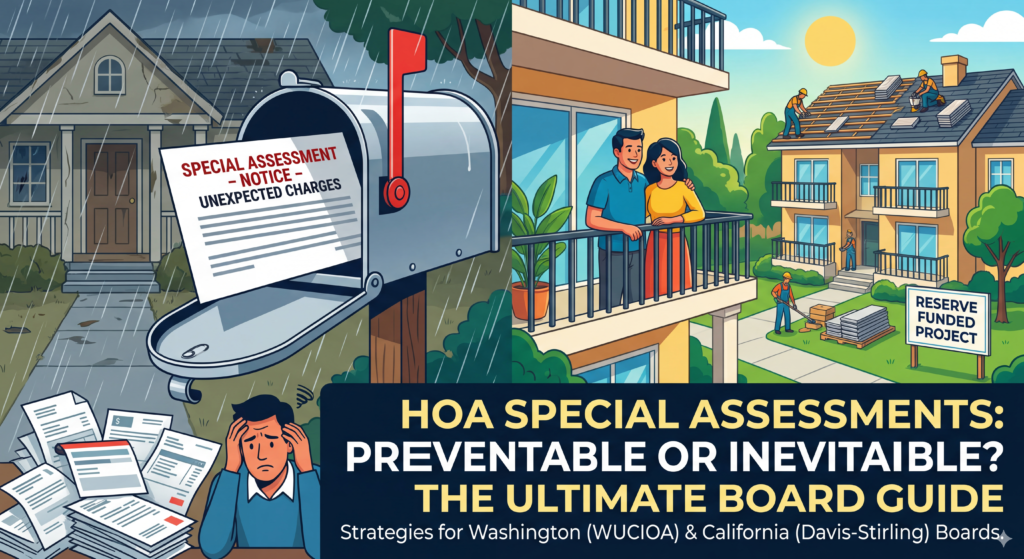
There is no more dreaded phrase in HOA governance than “special assessment.”
It arrives in homeowners’ mailboxes as an unexpected bill — sometimes for hundreds of dollars, sometimes for thousands — for a cost the community didn’t budget for or couldn’t cover from existing reserves. It triggers complaints, board recall efforts, and occasionally litigation. It damages trust between boards and homeowners in ways that take years to repair.
And in the vast majority of cases, it was preventable.
Special assessments are not random financial disasters. They are almost always the predictable result of years of underfunded reserves, deferred maintenance, or inadequate budgeting. Understanding how special assessments work — when they are legally permissible, how to pass them correctly, and what causes them — is essential for any HOA board member who wants to manage their community’s finances responsibly.
This guide covers special assessments in detail for Washington and California HOA and COA boards, including the legal requirements under WUCIOA (RCW 64.90) and the Davis-Stirling Act, the procedural steps for passing a valid special assessment, and the reserve funding practices that prevent them.
What Is a Special Assessment?
A special assessment is a one-time charge levied against homeowners in addition to their regular monthly or annual assessments. It is used to cover costs that the association’s operating budget and reserve fund cannot absorb — typically a major unexpected expense, an underfunded capital project, or a budget shortfall that accumulated over multiple years.
Special assessments are distinct from regular assessments in a few important ways. Regular assessments are set annually as part of the budget process and represent the predictable, ongoing cost of running the community. Special assessments are non-recurring, typically tied to a specific expense or project, and require separate board or member action depending on the amount and the applicable state law.
Special assessments can be levied as a lump sum — a single payment due by a specified date — or in installments spread over several months. For large assessments, installment payment plans are common and help reduce the immediate financial burden on homeowners.
When Are Special Assessments Legally Permissible?
Both Washington and California law permit special assessments, but each state imposes different thresholds for when member approval is required versus when the board can act alone.
Special Assessments Under WUCIOA in Washington
Under WUCIOA (RCW 64.90), the board has broad authority to levy assessments necessary to carry out the association’s responsibilities. The statute does not establish a specific dollar threshold above which member approval is automatically required for special assessments — the association’s governing documents control this, within the framework WUCIOA establishes.
This means Washington HOA boards need to review their CC&Rs and bylaws carefully to understand the limits of their assessment authority. Many pre-WUCIOA governing documents include provisions limiting the board’s ability to levy special assessments above a certain amount per unit without member approval. Under WUCIOA’s hierarchy of authority, governing document provisions that are consistent with the statute remain enforceable.
What WUCIOA does establish is that all assessment obligations must be disclosed clearly to owners, that the board’s financial decisions must be made in good faith and in the association’s interest, and that the budget and assessment process must follow the open meeting and notice requirements that have been in effect since January 1, 2026.
In practice, Washington boards considering a significant special assessment should review their governing documents, consult with a Washington community association attorney to confirm their authority and the required process, and provide owners with full transparency about the need for and amount of the assessment before it is levied.
Special Assessments Under the Davis-Stirling Act in California
California’s Davis-Stirling Act is more specific about the limits of board authority for special assessments. Under Civil Code §5610, a special assessment that in aggregate exceeds 5% of the association’s budgeted gross expenses for the fiscal year requires approval by a majority of a quorum of the association’s members.
This 5% threshold is lower than most boards expect. For an association with an annual operating budget of $400,000, the threshold is $20,000. A special assessment of $20,001 or more requires a member vote. For associations with smaller budgets, the threshold is correspondingly lower — an association with a $150,000 annual budget hits the member approval requirement at $7,500.
The member vote requirement for assessments above the threshold is not a procedural technicality. A special assessment levied without required member approval is legally vulnerable to challenge and may be unenforceable. Boards that proceed without the required vote — even when the need is urgent and the assessment amount is clearly justified — expose themselves and the association to significant legal risk.
For assessments below the 5% threshold, California boards can act without member approval. For assessments above the threshold, the board must notice and conduct a member vote following the secret ballot election procedures required under Davis-Stirling.
The Legal Process for Passing a Special Assessment
The exact process varies by state and by the association’s governing documents, but the following steps apply broadly to both Washington and California HOA boards.
Step 1: Confirm the Need and the Amount
Before taking any action, the board needs a clear picture of what the assessment is for, how much is needed, and why the existing operating budget and reserve fund cannot cover it. This means getting written estimates or bids for the project or expense, reviewing the current reserve fund balance and the reserve study to confirm the fund cannot absorb the cost, and documenting the board’s analysis and decision-making process in the meeting minutes.
The documentation step matters more than most boards realize. If the special assessment is later challenged, the board’s written record of its analysis and decision is the primary evidence that the board acted in good faith and within its authority.
Step 2: Determine Whether Member Approval Is Required
In California, apply the 5% gross expense threshold. If the assessment exceeds the threshold, member approval is required and the board cannot proceed without it. In Washington, review the governing documents and consult legal counsel if the assessment amount is significant or the documents are ambiguous.
If member approval is required, build the timeline backward from the date the funds are needed. A member vote under Davis-Stirling requires proper notice, a ballot period, and a counted result — the process takes a minimum of several weeks and often longer.
Step 3: Notice the Board Meeting and Vote
The board must vote to approve the special assessment (or, if member approval is required, to initiate the member vote process) at a properly noticed open meeting. In Washington, WUCIOA’s open meeting requirements have been in effect since January 1, 2026 — the meeting must be open to owners, properly noticed at least 14 days in advance, and conducted in accordance with all WUCIOA open meeting standards. In California, Davis-Stirling’s board meeting notice requirements apply.
The board vote should be recorded clearly in the minutes, including the specific amount of the assessment, the purpose, the payment timeline, and whether it is being levied as a lump sum or in installments.
Step 4: Conduct the Member Vote (If Required)
In California, a member vote on a special assessment must follow the same secret ballot election procedures required for board elections under Davis-Stirling. The board must use an inspector of elections, distribute ballots at least 30 days before the counting meeting, and conduct the counting at a properly noticed meeting. The assessment passes with approval by a majority of a quorum of members.
In Washington, if the governing documents require member approval for a special assessment above a certain threshold, the vote must follow whatever procedures the governing documents specify, consistent with WUCIOA’s election requirements including secret ballots.
Step 5: Notice the Assessment to Owners
Once the special assessment is approved — either by board vote alone or following a required member vote — it must be formally noticed to all owners. The notice should include the amount per unit, the purpose of the assessment, the payment due date or installment schedule, the consequences of non-payment (lien rights, late charges, interest), and any payment plan options the board is making available.
In California, the association’s collection and lien procedures under Davis-Stirling apply to special assessment delinquencies exactly as they apply to regular assessment delinquencies — including pre-lien notice requirements and payment plan obligations.
Step 6: Follow Up on Delinquencies
Special assessments generate higher delinquency rates than regular assessments, simply because the amounts are larger and the payment is unexpected. Have a plan for delinquency follow-up before the assessment is levied. Know your collection policy, pre-lien notice timelines, and payment plan terms. Be consistent in applying them — selective enforcement of collection procedures is both unfair and a source of legal exposure.
The Most Common Causes of Special Assessments — and How to Prevent Them
Understanding why special assessments happen is the most practical information a board can have, because the causes are overwhelmingly predictable and preventable.
Underfunded Reserves
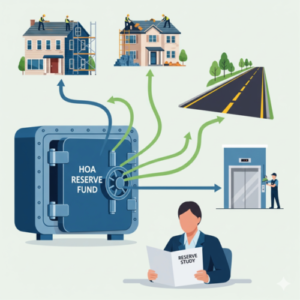
This is the root cause of most special assessments. The association’s reserve fund exists specifically to pay for major component repair and replacement — roofs, paving, pools, elevators, HVAC systems, exterior paint, concrete. When the reserve fund is adequately funded, these replacements can be paid for from reserves without any additional charge to homeowners. When it is underfunded, the money isn’t there when the project arrives.
Reserve underfunding accumulates gradually. A board that reduces the reserve contribution by $10,000 one year, and another $10,000 the next, and another the year after that — always in the interest of keeping assessments flat — creates a $30,000 gap that will eventually need to be filled. When the roof needs replacing and the reserve fund is $80,000 short of what the project costs, the money has to come from somewhere. That somewhere is a special assessment.
The prevention is straightforward but requires discipline: fund reserves at the level your reserve study recommends, every year, without reduction. A modest assessment increase now is almost always preferable to a large special assessment later.
Deferred Maintenance That Becomes an Emergency
Deferred maintenance is maintenance that should have been done but wasn’t — usually because the board wanted to avoid the cost in the current year. The problem is that deferred maintenance doesn’t disappear. It compounds. A $3,000 roof repair deferred for three years often becomes a $15,000 repair or a $50,000 replacement. The deferred cost plus the compounded damage always exceeds the original maintenance cost by a significant margin.
Boards that approve a maintenance budget and actually spend it — doing preventive maintenance on schedule, addressing small issues before they become large ones — spend dramatically less over time than boards that defer maintenance to keep annual costs low.
Insurance Coverage Gaps
An uninsured or underinsured loss — a fire, a water intrusion event, a liability claim that exceeds policy limits — can generate a special assessment that dwarfs anything a board expected to face. Annual insurance policy review, including confirmation that coverage limits are adequate for current replacement costs and that the policy covers the types of losses most relevant to the community’s physical characteristics, is one of the highest-leverage risk management activities a board can do.
In California, WUCIOA’s master policy requirements — which require coverage of units and, unless the declaration explicitly states otherwise, improvements and betterments — are particularly important to review for communities transitioning from older governing documents that may have defined insurance obligations differently.
Unexpected Legal Expenses
Litigation is expensive. A construction defect claim, an employment dispute, a fair housing complaint, or a contested board election can generate legal fees that overwhelm the association’s operating budget in a single year. While legal expenses can’t always be prevented, many situations that escalate to litigation could have been resolved earlier and less expensively with prompt, professional management and clear governance procedures.
Directors and officers insurance and general liability insurance provide important protection, but they have limits and exclusions. Associations that are involved in or anticipating significant litigation should address the potential financial exposure in the budget process — not discover it at year-end.
Communicating a Special Assessment to Homeowners
Even a legally valid, procedurally correct special assessment can create lasting damage to the board’s relationship with homeowners if it is communicated poorly. The principles that apply to communicating regular assessment increases apply with even more force to special assessments, because the stakes are higher.
Be transparent about what caused the need. Homeowners are far more accepting of a special assessment when they understand the specific situation that created it — an uninsured loss, a failed major component, a reserve fund that was underfunded under prior board leadership — than when they receive a bill with no explanation. Acknowledge the history honestly.
Explain what alternatives were considered. If the board evaluated borrowing, phased payments, or other approaches before settling on a special assessment, say so. Showing that the board did its homework builds credibility even when the news is bad.
Offer a payment plan. Requiring a large lump-sum payment on short notice creates real hardship for homeowners on fixed incomes or with limited liquidity. A reasonable installment option — typically three to twelve months — reduces hardship and reduces delinquency rates.
Make the board available for questions. A town hall meeting or an extended open forum at the next board meeting gives homeowners a chance to ask questions and express concerns in a structured setting. Boards that hide from homeowner reaction to a special assessment fare worse than boards that engage directly.
How AmLo Management Helps HOA Boards Avoid Special Assessments
The most important thing AmLo Management does to protect HOA and COA clients from special assessments is build budgets correctly from the start — with current vendor quotes, insurance renewals that arrive before budget deadlines, and reserve contributions that match what the reserve study actually recommends.
We work with qualified reserve specialists to ensure every community we manage has a current, accurate reserve study, and we treat the reserve contribution as a non-negotiable budget line rather than a number to be optimized for assessment optics. We track maintenance obligations proactively, address small issues before they compound, and review insurance coverage annually to ensure limits reflect current replacement costs.
When a special assessment becomes necessary despite best efforts — because sometimes it does, particularly when boards are taking over communities with years of prior underfunding — we manage the full process: documenting the need, advising on legal requirements under WUCIOA or Davis-Stirling, drafting owner communications, managing the member vote if required, and following up on delinquencies consistently and professionally.
Special assessments are not inevitable. They are the product of financial decisions — or the failure to make them — that accumulate over years. Contact AmLo Management to learn how we build the financial discipline that keeps communities out of special assessment territory.
Disclaimer: This post is provided for general informational purposes only and does not constitute legal advice or financial advice. HOA boards should consult with qualified legal counsel and financial professionals regarding their specific assessment authority and procedural obligations under applicable state law. Statutory requirements referenced reflect Washington and California law as understood in early 2026.