Every year, HOA boards across Washington and California sit down to approve a budget. Most finish the meeting feeling like they’ve done their job. And every year, a meaningful percentage of those budgets fall apart before the fiscal year ends — unplanned expenses drain the operating account, reserve contributions get deferred, and the board faces the uncomfortable conversation about a special assessment or an emergency fee increase.
The problem is rarely effort or intention. It’s process. Most HOA budgets are built by looking at last year’s numbers, adding a small percentage for inflation, and calling it done. That approach works fine when nothing changes. In practice, something always changes.
This guide walks through the process professional HOA managers use to build an annual budget that accounts for the real cost of running a community, funds reserves at the right level, and stays intact through the entire fiscal year.
Why Most HOA Budgets Fall Short
Before getting into the process, it’s worth understanding the patterns that cause HOA budgets to fail. They tend to cluster around a few recurring mistakes.
Underestimating operating costs is the most common. Boards look at what they spent last year and assume next year will be similar. But vendor contracts get renewed at higher rates, insurance premiums increase, utility rates change, and maintenance items that were deferred last year can’t be deferred again. A budget built on last year’s actuals without forward-looking adjustments will be short.
Underfunding reserves is the most consequential. Reserve contributions are the line item boards cut when they want to keep assessments flat. The logic feels reasonable in the short term — the roof doesn’t need replacing this year, so why fund it aggressively? The answer is that the cost of replacing a roof doesn’t go away when you defer the contribution. It compounds. Underfunded reserves lead directly to special assessments, which are more disruptive, more expensive per unit, and more damaging to community relationships than a modest annual assessment increase.
Ignoring one-time costs is a planning failure. Every community has expenses that don’t occur every year — a reserve study update, a governing document legal review, a parking lot restriping, a pool replastering. These aren’t surprises if you plan for them. They become surprises when boards only budget for routine recurring expenses.
Failing to account for delinquencies creates cash flow problems. Not every homeowner pays on time. A budget that assumes 100% collection will be short by whatever percentage of owners are chronically late or in collections. A realistic budget includes a delinquency reserve — typically 1% to 3% of total assessment revenue depending on the community’s collection history.
The Four Components of an HOA Budget
A well-structured HOA budget has four distinct components. Each serves a different purpose and requires a different analysis to build correctly.
Operating Expenses
Operating expenses are the recurring costs of running the community day to day. They include management fees, landscaping and common area maintenance, utilities for common areas, insurance premiums, accounting and audit fees, legal fees, pool and amenity maintenance, security and access systems, and administrative costs.
The key discipline in building the operating expense section is to budget from actual vendor quotes and contract terms — not from last year’s invoices with a percentage added. Contact each vendor before finalizing the budget and confirm their pricing for the coming year. If a contract is up for renewal, get it renewed before the budget is finalized so you’re working from real numbers.
Insurance premiums deserve special attention. HOA insurance has increased significantly in recent years, particularly in California where wildfire risk has driven major premium increases and coverage availability challenges. Get your insurance renewal quote early — ideally two to three months before your budget deadline — so you have an accurate number. An insurance renewal that comes in 20% or 30% higher than the prior year is a budget-busting surprise that’s entirely avoidable with early planning.
Reserve Contributions
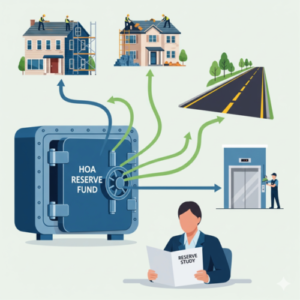
Reserve contributions are not discretionary. They are the annual funding required to ensure the reserve account has enough money to cover major component repair and replacement when those components reach the end of their useful life.
The right reserve contribution amount comes directly from your reserve study. A current reserve study — completed within the past year for WUCIOA communities in Washington, or within the past three years for California communities under the Davis-Stirling Act — will include a recommended annual contribution based on the current reserve balance, the funding goal, and the projected replacement costs and timelines for all major components.
There are three common reserve funding methodologies: the threshold method (maintaining a minimum balance at all times), the percent funded method (targeting a specific percentage of fully funded reserves, typically 70% to 100%), and the cash flow method (projecting annual inflows and outflows to ensure the account never goes negative). Your reserve specialist will recommend a methodology and a contribution amount. The board’s job is to fund it.
The most important thing to understand about reserve contributions is the cost of not funding them. An association that consistently contributes less than its reserve study recommends is borrowing from its future — and the bill comes due in the form of a special assessment when a major component needs replacement and the money isn’t there.
Contingency Reserve
A contingency line item — separate from the capital reserve account — gives the board flexibility to handle unexpected operating expenses without going over budget or dipping into reserves. A typical contingency amount is 5% to 10% of total operating expenses.
This is the line that pays for the irrigation system controller that fails in July, the unexpected legal letter that requires a response, or the pressure washing job that gets added mid-year when the board notices the building facade is overdue. Without a contingency, every unplanned expense is a budget variance. With a contingency, most unplanned expenses are absorbed without drama.
Delinquency Reserve
Assessment revenue is only as reliable as your collection rate. Budget your assessment revenue based on a realistic collection assumption, not a theoretical 100%. For most communities, a 97% to 99% collection assumption is reasonable. Communities with higher delinquency history should budget more conservatively — 94% to 96%.
The gap between your theoretical assessment revenue at 100% collection and your budgeted revenue at your realistic collection rate is effectively a delinquency reserve. It prevents cash flow problems when owners are late or in the collections process.
The Budget Building Process — Step by Step
Step 1: Pull Your Prior Year Actuals
Start with a complete year-end financial statement for the prior fiscal year. Line by line, note where you came in over budget, under budget, and on target. The variances tell the story — they reveal where your prior budget assumptions were wrong and what you need to correct this year.
Pay particular attention to line items that came in significantly over budget. These are the expenses that tend to repeat. If landscaping ran 15% over because of drought surcharges, assume drought surcharges again next year. If utilities came in high because of a rate increase mid-year, the new rate is your starting point — not last year’s full-year average.
Step 2: Gather Forward-Looking Data
Before you build a single number in the new budget, collect the following: renewed or renewing vendor contracts with confirmed pricing, insurance renewal quote, utility rate schedules for the coming year, reserve study (current or updated), any planned capital projects identified in the reserve study, pending legal matters that may require attorney involvement, and any deferred maintenance items from prior years that must be addressed.
This step takes time — typically two to three months of advance work if you’re doing it properly. Which means the budget process should start three to four months before the fiscal year begins, not three weeks.
Step 3: Build the Operating Expense Budget Line by Line
With actual vendor quotes in hand, build each operating expense line from the ground up. Don’t start from last year’s budget — start from this year’s confirmed pricing. For line items without a firm quote yet (minor supplies, miscellaneous maintenance), use last year’s actuals adjusted for known inflation factors.
Group expenses by category — maintenance and repairs, utilities, management, insurance, professional services, administrative — so the budget is readable and comparable across years.
Step 4: Set the Reserve Contribution
Pull the recommended annual contribution from your current reserve study. If the reserve study is more than a year old (required annually under WUCIOA in Washington, and every three years under Davis-Stirling in California), commission an update before finalizing the budget.
Do not reduce the reserve contribution to hit an assessment target without a professional analysis of the impact on your reserve funding trajectory. If the recommended contribution requires an assessment increase that feels politically difficult, the right response is to explain the reserve funding situation to owners — not to underfund the reserves and defer the problem.
Step 5: Calculate the Total Assessment Revenue Required
Add your total operating expenses, reserve contribution, contingency, and delinquency buffer. The total is your required revenue. Divide by the number of units (or by the percentage of ownership interest if your documents allocate assessments by interest rather than equally) to get the required monthly assessment per unit.
Compare that to the current assessment. If the required assessment is higher, you have an increase to communicate. If it’s lower — which happens occasionally when a major contract renews favorably or a one-time expense doesn’t recur — you have the option of holding the assessment flat and building a slightly larger operating buffer.
Step 6: Present the Draft Budget to the Board
Present the draft budget with a clear summary narrative — not just the numbers, but the story behind the key changes. If insurance is up 18%, explain why. If the reserve contribution is increasing, explain what the reserve study recommends and what the consequence of not funding it would be. Board members who understand the reasoning behind the numbers are much better equipped to explain the budget to homeowners.
Step 7: Distribute and Adopt the Budget
Under California’s Davis-Stirling Act, the Annual Budget Report must be distributed to all members 30 to 90 days before the start of the fiscal year. Under WUCIOA in Washington, budget disclosure obligations have similar advance notice requirements. Know your statutory deadline and build backward from it when scheduling the board approval meeting.
Once adopted, the budget is a commitment — not a ceiling. Track actuals against budget monthly. Address variances early, before small overruns become structural problems.
Assessment Increases — How to Communicate Them
No part of HOA governance generates more owner frustration than an assessment increase. Most of that frustration is the product of poor communication, not the increase itself. Owners who understand why the assessment is going up — and who trust that the board has been responsible stewards of the money — accept increases far more readily than owners who feel like increases come out of nowhere.
The keys to communicating an assessment increase well are transparency, specificity, and advance notice. Don’t announce an increase at the budget adoption meeting and expect it to land well. Give owners advance notice that the budget is being developed, explain the major cost drivers before the final number is set, and present the adopted budget with a clear written explanation of what’s driving the change.
Specific explanations work better than general ones. “Insurance increased 22% due to market conditions affecting all California community associations” is more credible and easier to accept than “costs went up.” “The reserve study recommends a $15,000 increase in annual contributions to maintain adequate funding for roof replacement in 2031” is more persuasive than “we need more money in reserves.”
Under California’s Davis-Stirling Act, the board may increase regular assessments by up to 20% per year without member approval. Under WUCIOA in Washington, assessment authority is similarly broad within the board’s budget authority. But having the legal authority to raise assessments doesn’t mean the communication process doesn’t matter. Boards that communicate well have fewer disputes, less board member turnover, and better long-term community relationships.
Reserve Studies and the Budget — The Connection Most Boards Miss
The single most common source of HOA budget failure is the disconnect between the reserve study and the operating budget. Many boards treat the reserve study as a separate document — something the reserve specialist produces every few years and files away — rather than as the primary input to the reserve contribution line in the annual budget.
The reserve study is the financial plan for your major components. The annual budget is the operational plan for the current year. They are supposed to connect — the reserve study tells you how much to contribute this year, and the budget commits the association to contributing that amount.
When boards don’t use the reserve study as a budget input, reserve contributions become a number the board picks rather than a number the analysis requires. Over time, those picked numbers are almost always too low. The result is an underfunded reserve account and, eventually, a special assessment.
If your community doesn’t have a current reserve study, commissioning one should be the first step in your next budget cycle — not an afterthought.
How AmLo Management Handles Budgets for HOA and COA Clients
Building an accurate, sustainable HOA budget requires advance planning, vendor coordination, reserve study integration, and clear communication with owners. For volunteer boards managing this on top of full-time jobs and family obligations, the process is genuinely demanding.
AmLo Management handles the full budget development process for every community we manage. We gather vendor quotes, coordinate insurance renewals, work with reserve specialists to ensure contributions match the current study recommendations, build the draft budget for board review, prepare the required budget disclosure documents under both Washington and California law, and support the board in communicating the adopted budget to owners.
Our flat, all-in pricing model means there are no surprise management fees or administrative markups that inflate your operating budget. What we quote is what the budget reflects — no hidden line items, no end-of-year reconciliation surprises.
If your community is struggling with budget accuracy, reserve funding, or assessment communication, contact AmLo Management to learn how we approach financial management differently.
Disclaimer: This post is provided for general informational purposes only and does not constitute legal advice or financial advice. HOA boards should consult with qualified professionals regarding their specific budgeting, reserve funding, and assessment obligations. Statutory requirements referenced reflect Washington and California law as understood in early 2026.