If your California condominium association has not yet completed its SB 326 inspection, you are not alone — but you are exposed.
Senate Bill 326, signed into law in 2019 and codified at California Civil Code §5551, required condominium associations with three or more units to complete their first inspection of exterior elevated elements — balconies, decks, stairways, walkways, and their structural supports and railings — by January 1, 2025. That deadline has passed. Associations that missed it are operating with unverified elevated structures, potential safety hazards they don’t know about, and significant legal exposure if something goes wrong.
This guide covers exactly what SB 326 requires, who it applies to, what the consequences of non-compliance look like, and what your board needs to do right now to get into compliance and protect both your residents and your directors.
What Is SB 326 and Why Was It Enacted?
SB 326 — Senate Bill 326, authored by Senator Jerry Hill — was California’s legislative response to a string of catastrophic balcony and deck failures across the state, most notably the 2015 Berkeley balcony collapse that killed six college students and injured seven others. That structure failed due to dry rot that had gone undetected for years, concealed behind waterproofing materials that made visual inspection from the exterior impossible.
The pattern was familiar to structural engineers and building inspectors across California: elevated wood-framed structures are highly susceptible to moisture intrusion, and once moisture gets behind waterproofing membranes, the deterioration is hidden. By the time visible signs appear — soft spots, discoloration, surface deformation — the structural damage is often severe. Associations had no systematic obligation to inspect these elements, and many didn’t.
SB 326 changed that. It created a mandatory, recurring inspection obligation for California condominium associations, requiring licensed structural engineers or architects to physically examine exterior elevated elements on a defined cycle and report on their condition. The goal is to find and fix deterioration before structures fail — not after.
Who Does SB 326 Apply To?
SB 326 applies to condominium associations — associations formed under the Davis-Stirling Common Interest Development Act that include residential units stacked vertically, with shared structural systems and common area elevated elements.
Specifically, Civil Code §5551 applies to common interest developments with buildings that have three or more multifamily dwelling units and that have exterior elevated elements. Single-family HOAs and planned unit developments where homes share only horizontal lot boundaries and do not have shared elevated structures are generally not covered.
If you are unsure whether SB 326 applies to your community, the safest answer is to assume it does and consult with a California community association attorney and a licensed structural engineer. The cost of an unnecessary consultation is trivial compared to the liability exposure of missing a required inspection.
What Counts as an Exterior Elevated Element?
SB 326 defines exterior elevated elements broadly. The statute covers load-bearing components and associated waterproofing systems for structures that extend beyond the exterior walls of a building and are designed for human occupancy or use, where the walking surface is six feet or more above ground level.
In practical terms this includes balconies and decks, stairways and stairwells serving multiple units, elevated walkways and breezeways, landings and entry platforms above six feet, and the structural supports, columns, beams, joists, and railings associated with all of the above.
It does not cover roofs, parking structures, or ground-level patios and walkways.
What Does SB 326 Actually Require?
The Inspection Itself
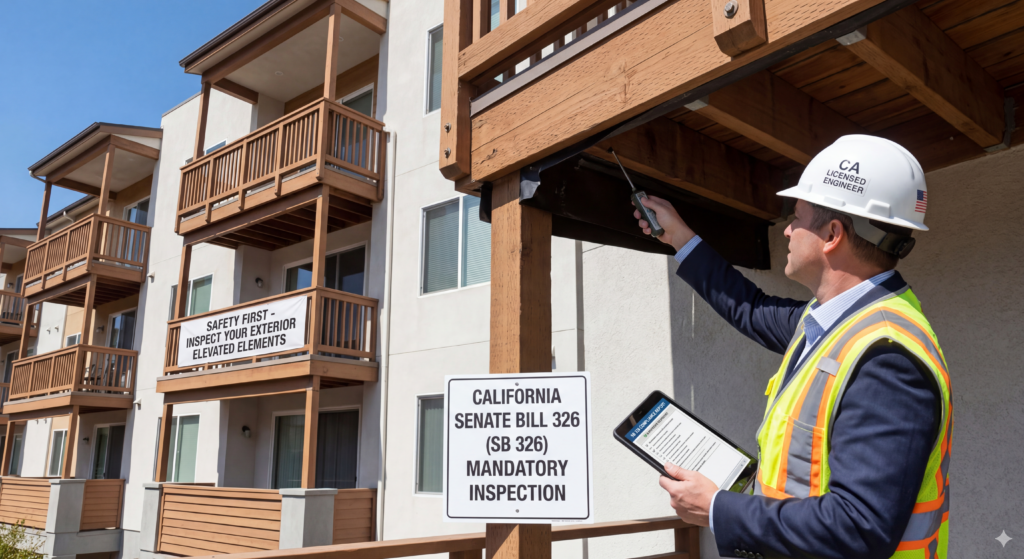
SB 326 requires that exterior elevated elements be inspected by a licensed structural engineer or licensed architect — not a general contractor, not a home inspector, and not the association’s maintenance staff. The inspector must be licensed by the State of California and must have the professional qualifications to evaluate structural integrity.
The inspection must be a visual inspection of a statistically significant sample of the exterior elevated elements, as defined by generally accepted statistical sampling methods. In practice, this typically means inspecting all accessible elevated elements, with the structural engineer determining what constitutes a statistically significant sample based on the number, age, and construction type of the structures being inspected.
The inspection must cover the current condition of the elements, whether they are in a generally safe condition and free from a condition that poses an immediate threat to the health or safety of residents, and the expected useful life of the elements or the need for replacement.
The Written Report
Following the inspection, the licensed structural engineer or architect must provide a written report to the association. The report must identify each type of exterior elevated element inspected, describe the current condition of the elements, identify any immediate safety hazards, recommend any necessary repair or replacement, and include the inspector’s determination of the expected remaining useful life of the elements.
The association must keep this report in its association records. It must be made available to members upon request. When a unit is sold, the report must be disclosed to the prospective buyer as part of the resale disclosure package.
The Inspection Cycle
SB 326 establishes a nine-year inspection cycle. Once an association completes its initial inspection, the next inspection is required within nine years. The inspection cycle runs independently of the reserve study cycle, though the findings should inform the reserve study — particularly the estimated remaining useful life and replacement cost of elevated elements.
What Happens When Immediate Safety Hazards Are Found
If the inspection reveals a condition that poses an immediate threat to the health or safety of residents, the association is required to take immediate preventive measures — which may include restricting access to the affected structure — and must notify all residents of the finding. The association must then complete repairs as quickly as practicable.
This is not optional. An association that receives a report identifying an immediate safety hazard and fails to act faces severe liability exposure if a resident or guest is subsequently injured on that structure.
The January 1, 2025 Deadline — and What Happens If You Missed It
For condominium associations with buildings that were in existence before 2020, the first SB 326 inspection was required to be completed by January 1, 2025. For buildings completed in 2020 or later, the first inspection is due within six years of the date the building received its certificate of occupancy.
January 1, 2025 has passed. If your association has not completed its initial SB 326 inspection, you are currently out of compliance with California law.
What Non-Compliance Looks Like in Practice
SB 326 does not specify a per-day fine or administrative penalty for non-compliance the way some other California statutes do. The liability exposure is more direct and more serious than a regulatory fine.
If a resident or guest is injured on an elevated structure that should have been inspected under SB 326 — a balcony railing that fails, a deck that collapses, a stairway that gives way — the association’s failure to conduct the required inspection becomes central evidence in a personal injury or wrongful death lawsuit. The plaintiff’s attorney will establish that the law required an inspection, that the inspection was not done, and that the failure to inspect is why the hazard went undetected and unaddressed.
Board members can face personal liability in this scenario, particularly if the board was aware of the SB 326 requirement and failed to act. Directors and officers insurance provides some protection, but policies have coverage limits and exclusions, and personal liability exposure in catastrophic injury or death cases can exceed policy limits.
Beyond litigation exposure, non-compliance creates problems for unit sales. SB 326 inspection reports are required resale disclosures. An association that has no report to disclose — because it never completed the inspection — creates uncertainty for buyers, their lenders, and their attorneys that can complicate or delay sales.
If You Missed the Deadline, Act Immediately
The right response to a missed deadline is not to wait and hope nothing happens. It is to schedule the inspection as soon as possible, document the board’s decision to do so, and get the inspection completed. An association that acts promptly after missing a deadline is in a meaningfully better position than one that continues to delay.
Contact a licensed structural engineer with California condominium inspection experience. Explain the SB 326 requirement and request a proposal for the inspection. Prioritize completing the inspection before the next association meeting so the board can report on the status to members.
How SB 326 Intersects With Your Reserve Study
SB 326 inspection findings should feed directly into your association’s reserve study. The reserve study is required to identify all major components with a remaining useful life of 30 years or less, estimate their replacement cost, and calculate the annual contribution needed to maintain adequate funding.
Exterior elevated elements — balconies, decks, walkways, stairways — are major components. Their remaining useful life and estimated replacement cost should be based on real inspection data, not general estimates. An SB 326 inspection report from a licensed structural engineer is the most reliable input available for the reserve study’s analysis of these components.
If your reserve study was completed before your SB 326 inspection, or if the study used estimated useful life figures without the benefit of an actual structural inspection, it should be updated to reflect the inspection findings. An underfunded reserve account for elevated element replacement is a financial and safety problem — the kind that produces special assessments and deteriorated structures simultaneously.
How SB 326 Relates to SB 721 — The Sister Statute for Rental Buildings
California enacted two companion balcony inspection statutes in 2019. SB 326 covers condominium associations governed by the Davis-Stirling Act. SB 721 covers multifamily residential buildings with three or more units that are not condominiums — primarily apartment buildings owned by a single landlord.
If your community includes any buildings that operate as rentals under single ownership rather than as individually owned condominiums, SB 721 may apply to those structures even if SB 326 governs the condominium units. Associations with a mix of ownership structures should confirm with legal counsel which statute applies to which buildings.
What to Look for in an SB 326 Inspector
Not every structural engineer or architect has experience with SB 326 inspections or with the specific failure modes common in California multifamily elevated structures. When evaluating inspectors, boards should look for demonstrated experience with SB 326 and California condominium inspections, familiarity with wood-framed elevated structure deterioration and moisture intrusion, the ability to access and inspect elements that may require opening up waterproofing or cladding to assess concealed conditions, professional liability insurance adequate for the scope of the inspection, and the ability to provide a written report that satisfies the statutory requirements.
Ask specifically whether the inspector’s scope includes probing for concealed deterioration in elements where the exterior waterproofing may be intact but the underlying structure may have experienced moisture damage. Surface-only visual inspections can miss exactly the kind of concealed rot that caused the Berkeley balcony collapse.
SB 326 Compliance Checklist for California Condo Boards
Confirm whether SB 326 applies to your association — three or more multifamily units with exterior elevated elements six feet or more above grade.
Determine whether your initial inspection has been completed. If yes, confirm the date and locate the written report in your association records.
If the inspection has not been completed, engage a licensed structural engineer or architect immediately and schedule the inspection.
Once the inspection is complete, review the written report with the board. Identify any immediate safety hazards and take required action. Identify elements with limited remaining useful life and ensure they are reflected in the reserve study.
Update the reserve study to incorporate SB 326 inspection findings for all exterior elevated elements.
Confirm that the inspection report is included in your association’s records and will be included in resale disclosures.
Calendar the next inspection — nine years from the completion of the initial inspection.
How AmLo Management Handles SB 326 for California COA Clients
SB 326 compliance is one of the most consequential obligations California condominium associations carry, and it is one that volunteer boards frequently underestimate — both in terms of the legal requirement and the liability exposure that comes with missing it.
AmLo Management coordinates SB 326 inspection scheduling and compliance tracking for all California condominium associations we manage. We maintain inspection records, track the nine-year reinspection cycle, ensure findings are properly incorporated into reserve study updates, and include the inspection report in resale disclosure packages. When an inspection identifies repair or replacement needs, we coordinate the bidding and project management process.
Our Marina del Rey office serves condominium communities throughout Los Angeles and Ventura counties — from Marina del Rey and Santa Monica to Thousand Oaks, Simi Valley, and Santa Clarita. If your COA has not yet completed its SB 326 inspection, contact us to discuss how we can help you get into compliance quickly and manage your ongoing obligations going forward.
Disclaimer: This post is provided for general informational purposes only and does not constitute legal advice. California condominium associations should consult with qualified legal counsel and a licensed structural engineer regarding their specific SB 326 compliance obligations. Information reflects the law as understood in early 2026; subsequent legislative changes may affect accuracy.