Of all the friction points in HOA governance, few are more persistent or more avoidable than homeowner confusion about fees.
It shows up at every annual meeting, in emails to board members, in Nextdoor threads that spiral into neighborhood conflict. Where is my money going? Why did fees go up again? What is the management company actually doing? Why do I pay the same as my neighbor when their unit is twice the size?
Most of this friction is not about the fees themselves. It is about the absence of a clear, accessible explanation of what those fees are for. Homeowners who understand what they are paying for — and why — accept fees, and even fee increases, far more readily than homeowners who receive a monthly charge with no context.
This guide is written for both audiences: homeowners who want to understand their HOA fees, and board members who want to explain them better.
What Are HOA Fees?
HOA fees — also called assessments, dues, or maintenance fees depending on the association and the state — are the regular charges that homeowners in a managed community pay to fund the shared costs of operating and maintaining the community.
When you buy a home in an HOA or condominium community, you are buying into a shared ownership arrangement. The community’s common areas — the landscaping, the pool, the parking lot, the building exterior in a condominium — belong to all owners collectively, through the association. The costs of maintaining those shared assets are divided among all owners and collected through regular assessments.
HOA fees are not optional and not negotiable. When you purchase a home in a managed community, you agree to pay the association’s assessments as a condition of ownership. The obligation is recorded in the community’s CC&Rs — the declaration of covenants, conditions, and restrictions — which are recorded against every property in the community and run with the land. If you sell the home, the obligation transfers to the buyer.
What Do HOA Fees Actually Cover?
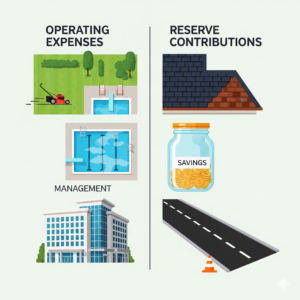
HOA fees fund two distinct buckets: operating expenses and reserve contributions. Understanding the difference between these two is the foundation of understanding where your money goes.
Operating Expenses
Operating expenses are the ongoing, recurring costs of running the community. Every dollar collected for operating expenses is spent within the current fiscal year on services and maintenance the community needs right now. Operating expenses typically include the following.
Landscaping and grounds maintenance is usually the largest operating expense for HOA communities — often 25% to 40% of the total operating budget. This covers lawn mowing, irrigation maintenance, seasonal plantings, tree trimming, weed control, and the general upkeep of common area grounds. For communities with extensive landscaping, drought-resistant plantings in California, or complex irrigation systems, this cost is significant.
Common area utilities include the electricity for common area lighting, parking lot lights, signage, and amenity facilities; water for irrigation systems and pool maintenance; and gas for common area heating where applicable. Utility costs are largely outside the association’s control — they are driven by rate structures and consumption, both of which can change year to year.
Insurance is one of the most significant and least understood line items in the HOA budget. The association carries a master property insurance policy covering the common areas and — in most condominium communities — the buildings themselves, including in many cases the unit interiors. It also carries general liability insurance, directors and officers liability insurance, and fidelity bond coverage protecting against employee dishonesty. Insurance premiums have increased significantly in recent years, particularly in California where wildfire risk has driven major market disruptions.
Professional management fees are the cost of the management company — the professional firm that handles day-to-day operations, vendor coordination, financial management, owner communication, and compliance with applicable state law. For Washington communities, this includes WUCIOA compliance support. For California communities, it includes Davis-Stirling compliance, election administration, and SB 326 tracking for condominium clients.
Pool and amenity maintenance covers the chemical treatment, equipment maintenance, safety inspection, and lifeguard services (if applicable) for community pools and spas; court maintenance for tennis and pickleball courts; fitness equipment service; and clubhouse cleaning and maintenance.
Professional services include the association’s accountant or CPA (for annual audits or financial reviews required by state law), the association’s attorney (for legal guidance, contract review, and enforcement matters), and the reserve specialist (for the annual or triennial reserve study required under applicable state law).
Administrative costs cover insurance for the management company’s services, postage and printing for required notices and disclosures, bank fees for the association’s operating and reserve accounts, and software and technology costs for owner portals, payment processing, and communication platforms.
Reserve Contributions
A portion of every HOA assessment goes into the reserve fund — the dedicated savings account that pays for major capital repairs and replacements when major components reach the end of their useful life.
Unlike operating expenses, reserve contributions are not spent in the current year. They accumulate over time so that when the roof needs replacing, or the parking lot needs to be repaved, or the pool plaster needs to be refinished, the money is available without a special assessment.
The reserve contribution portion of your assessment is essentially forced savings for future capital needs. An association with a well-funded reserve account is one where major replacements can be handled from existing savings rather than emergency charges to homeowners.
How much of your total assessment goes to reserves varies by community — typically 15% to 35% of the total, depending on the age of the community, the types and condition of major components, and the current reserve funding level. A newer community with all major components in good condition may have lower reserve contributions. An older community catching up on years of underfunding may have higher ones.
What HOA Fees Don’t Cover
Understanding what HOA fees don’t cover is just as important as understanding what they do — because unrealistic expectations about what the association will pay for are a major source of homeowner frustration.
HOA fees do not cover the interior of individual units. In most HOA communities, the association is responsible for common areas, and individual owners are responsible for everything within their own property boundaries. In condominiums, the boundary between association responsibility and owner responsibility is defined by the CC&Rs — often described as “from the studs in” or “from the unfinished surfaces in.” Interior finishes, appliances, plumbing and electrical within the unit walls, and personal property are the owner’s responsibility.
HOA fees do not cover individual owner utility bills. The association pays for utilities serving common areas. Individual unit utility accounts — electricity, gas, water, internet — are the owner’s responsibility.
HOA fees do not cover repairs caused by owner negligence or misuse. If an owner causes damage to common area property — through a plumbing leak originating within the unit, through vehicle damage to parking structures, or through unauthorized modifications to common elements — the association may charge the cost of repair back to that owner.
HOA fees do not cover improvements that individual owners want but the community hasn’t approved. Landscaping upgrades to a specific owner’s front yard, parking space modifications, or amenity additions that benefit only certain owners are not funded by the association.
Why HOA Fees Increase
Assessment increases are the most reliably contentious topic in HOA governance. Understanding why fees increase — and why some increases are unavoidable — helps homeowners evaluate whether an increase is reasonable.
Vendor cost inflation is the most common driver of operating budget increases. Landscaping contractors, insurance carriers, utility providers, and management companies all adjust their pricing over time. An association that has held assessments flat for several years while vendor costs have risen is running an operating deficit that will eventually need to be corrected.
Insurance premium increases have been particularly significant in recent years. In California, wildfire risk has caused many insurers to exit the market or dramatically increase premiums. HOA insurance premiums in some California markets have increased 40% to 80% in a single renewal cycle. This is not discretionary spending — the association is required to maintain insurance, and the premium is what the market charges.
Reserve contribution increases happen when the reserve study identifies underfunding. If a prior board held assessments flat by reducing reserve contributions, the reserve fund fell behind its funding targets. When a new board or a new management company conducts a current reserve study and identifies the gap, addressing it requires increasing contributions — which increases total assessments.
New regulatory requirements generate costs. Washington’s WUCIOA open meeting requirements that took effect January 1, 2026 added administrative costs for communities that need to implement compliant notice, agenda, and meeting procedures. California’s SB 326 balcony inspection requirement generates inspection costs that weren’t in prior budgets. Compliance with evolving state law is a cost of operating a managed community.
Capital project costs that exceed reserve fund capacity. When a major component fails before the reserve fund has accumulated sufficient funds — or when the actual replacement cost exceeds the reserve study estimate — the gap may require a special assessment or an operating budget contribution in addition to the reserve draw.
Why Some Homeowners Pay Different Amounts
In many communities, not all homeowners pay the same assessment amount. The basis for assessment allocation is defined in the CC&Rs and varies by community type and structure.
Equal allocation is the most common structure for planned unit developments and many HOA communities — every unit pays the same monthly assessment regardless of unit size, value, or usage. This is administratively simple but can feel inequitable to owners of smaller units who pay the same as owners of much larger properties.
Percentage of interest allocation is common in condominium communities. Each unit is assigned a percentage of ownership interest in the common elements — typically based on unit size — and assessments are charged in proportion to that interest. A unit with a 1.5% ownership interest pays 50% more than a unit with a 1% interest.
Tiered allocation by unit type is used in some communities where units are grouped into categories by size or type, with each category paying a different assessment amount. This can be a compromise between equal allocation and full percentage allocation.
Whatever allocation method your community uses is defined in the recorded CC&Rs and cannot be changed without amending those documents — which typically requires a supermajority member vote.
How to Read Your HOA Financial Statement as a Homeowner
Most associations make financial information available to owners upon request, and many distribute financial summaries at annual meetings or through owner portals. Understanding what the financial statement tells you helps homeowners evaluate whether their assessment dollars are being managed responsibly.
The income statement shows assessment revenue collected versus budget, and actual expenses versus budget for each line item. A well-managed association should be tracking close to budget on both sides. Significant variances — whether from unexpected expenses or from revenue shortfalls due to delinquencies — are worth asking the board about.
The balance sheet shows the association’s assets and liabilities at a point in time. The most important figures for owners are the operating account balance (which should reflect adequate liquidity for near-term expenses) and the reserve fund balance (which should be compared against the reserve study’s funding target to assess adequacy).
The accounts receivable aging shows which owners are delinquent on assessments and by how much. A high delinquency rate puts pressure on the association’s cash flow and may eventually require other owners to subsidize the shortfall through assessment increases.
The reserve fund statement shows contributions received, expenditures made, and the current balance compared to the reserve study target. This is one of the most important documents for understanding the community’s long-term financial health.
What Homeowners Can Do When They Have Questions About Fees
If you have questions about your HOA fees — what they cover, why they increased, or how the money is being spent — there are several constructive ways to get answers.
Request the annual budget and financial statements. Under both California’s Davis-Stirling Act and Washington’s WUCIOA, homeowners have the right to inspect association financial records. The annual budget should tell you exactly how the assessment is allocated across operating and reserve accounts. The financial statements should show you what has actually been spent.
Attend board meetings. Board meetings are open to homeowners under both WUCIOA and Davis-Stirling. The financial report presented at each board meeting provides a current picture of where the association stands against budget. Attending meetings regularly is the most effective way to stay informed about how the community’s finances are being managed.
Ask the management company directly. The management company is a resource for homeowner questions about fees, assessments, and financial management. A professional management company should be able to explain what your assessment covers, why it changed, and where to find more detailed information.
Submit a written records request. If you want to review the association’s financial records in detail — vendor contracts, bank statements, reserve study, check register — you have the right to do so under applicable state law. Submit a written request to the management company or board specifying what records you want to review.
Participate in the budget process. Many associations hold an open board meeting to review and adopt the annual budget before it takes effect. This is the most constructive time to ask questions about upcoming expenses and assessment levels — before the budget is final, when input can still be considered.
How Boards Can Communicate Fees More Effectively
For board members reading this: homeowner frustration about fees is usually a communication failure, not a governance failure. The fees may be entirely justified — the communication of what they cover and why they changed may simply be inadequate.
The most effective fee communication is specific, proactive, and honest. Specific means breaking down the assessment into its components — operating versus reserve, and within operating, the major categories — so homeowners can see where the money goes. Proactive means communicating before the increase takes effect, not after homeowners receive a higher bill. Honest means acknowledging when increases are driven by catch-up funding for years of underfunded reserves, rather than attributing everything to inflation.
An annual budget letter — a one or two page plain-language explanation of the adopted budget, distributed to all homeowners with the required annual disclosure package — is one of the highest-value communication tools a board can produce. It doesn’t have to be long. It has to be clear, specific, and accurate.
Town hall meetings before major assessment changes give homeowners a forum to ask questions and hear the board’s reasoning directly. They don’t eliminate opposition, but they reduce the sense of being ambushed by a financial decision that was made without input.
Owner portals that give homeowners access to their payment history, the association’s financial statements, governing documents, and communication archives reduce information asymmetry. When homeowners can see the same financial information the board sees, “where is my money going?” becomes a question with a readily available answer rather than a source of suspicion.
How AmLo Management Supports Transparent Fee Communication
AmLo Management believes that financial transparency is not just a governance value — it is a practical strategy for building the homeowner trust that makes community management work.
We prepare plain-language budget summaries for every community we manage and distribute them with the required annual disclosure package. We maintain owner portals with full access to financial statements, meeting minutes, governing documents, and association records. We attend annual meetings and are available to answer homeowner questions about fees, budgets, and financial management directly.
Our flat, all-in pricing model means there are no hidden management fees inflating the operating budget — what the board sees in the management fee line is what the community actually pays. No markups, no ancillary charges, no surprises on the monthly statement.
If your community is struggling with homeowner trust around fees and financial management — whether because of years of inadequate communication, a recent assessment increase that landed badly, or simply a desire to do better — contact AmLo Management to learn how we approach financial transparency as a core part of community management.
Disclaimer: This post is provided for general informational purposes only and does not constitute legal advice. Assessment obligations, financial disclosure requirements, and homeowner rights vary by state and by the association’s governing documents. Homeowners and board members should consult with qualified legal counsel regarding their specific rights and obligations. Statutory requirements referenced reflect Washington and California law as understood in early 2026.