Most people who join an HOA board do so because they care about their community. They want better maintenance, more responsive management, or a voice in decisions that affect their home and their neighbors. What they rarely have, when they raise their hand and get elected, is a clear picture of what the job actually requires.
Board roles in HOA governance are not ceremonial. Each officer position carries specific legal and operational responsibilities, responsibilities that, if neglected or misunderstood, create real consequences for the association and personal liability exposure for the board member. Yet the vast majority of newly elected board members receive no formal orientation, no written job description, and no training on what their role actually entails.
This guide provides exactly that: a plain-language breakdown of what each HOA board officer position is responsible for, where the authority boundaries lie, and the most common ways each role breaks down in practice.
How HOA Board Governance Works: The Basics
Before diving into individual roles, it helps to understand how HOA board governance is structured at a foundational level.
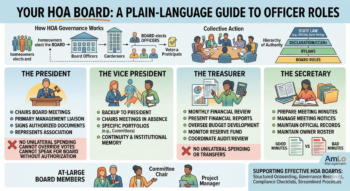
The board of directors is the governing body of the association. It acts collectively, meaning board authority is exercised through majority votes at properly noticed meetings, not through individual board members acting unilaterally. A single board member, including the president, has no authority to make binding decisions for the association outside of a properly noticed meeting and vote.
The board operates within a hierarchy of authority that runs from state law at the top, through the association’s recorded declaration (CC&Rs), to the bylaws, and finally to the board’s own rules and resolutions. When any of these conflict, the higher level of authority governs. State law (including WUCIOA in Washington and the Davis-Stirling Act in California) overrides anything in the governing documents that conflicts with it.
Officers of the association (president, vice president, treasurer, secretary) are typically elected by the board from among its members, not directly by homeowners. The homeowners elect the board; the board elects its officers. This distinction matters because it means officer positions can change without a community-wide election, and the board can remove an officer from their officer position without removing them from the board.
The HOA President
The president is the chief executive officer of the association: the board’s primary spokesperson, meeting chair, and point of contact for the management company. It is the most visible role on the board and carries significant responsibility for organizational leadership, even though its formal legal authority is narrower than most presidents realize.
What the President Is Actually Responsible For
The president chairs board meetings. This is one of the president’s most important and most time-consuming responsibilities. Running a productive, legally compliant board meeting requires understanding the agenda, managing discussion, recognizing owners for their right to speak before board votes (as required by WUCIOA and Davis-Stirling), calling and managing executive sessions correctly, and ensuring that decisions are made by board vote and recorded accurately in the minutes.
The president serves as the primary liaison to the management company. In a professionally managed community, the president is typically the management company’s first point of contact for issues requiring board awareness or direction. This doesn’t mean the president has authority to direct the management company unilaterally (decisions that affect the community’s finances, policies, or contracts require board approval), but day-to-day communication typically flows through the president.
The president signs contracts and legal documents on behalf of the association, pursuant to board authorization. The president does not have authority to sign contracts that the board has not authorized. A president who signs a vendor contract, settlement agreement, or other binding document without prior board approval may create personal liability exposure and a potentially unenforceable or disputed agreement.
The president represents the association in certain legal and official contexts: signing government filings, interacting with attorneys under board direction, and serving as the association’s representative in formal proceedings.
What the President Cannot Do Unilaterally
This is where many boards run into trouble. Presidents who don’t understand the limits of their authority (or who do understand them but exceed them anyway) create serious problems for their associations.
The president cannot make financial decisions without board approval. Directing the management company to pay an unapproved vendor, authorizing an unbudgeted expense, or committing to a contract without board vote are all actions outside the president’s authority, even if they seem reasonable in the moment.
The president cannot override other board members’ votes. The president’s vote counts the same as any other board member’s vote. A 3-2 board decision against the president’s position is final. The president cannot unilaterally reverse it.
The president cannot speak for the board to homeowners or the media without board authorization. Statements made by the president that commit the association to a position or action are binding only if the board has authorized that position.
The Vice President
The vice president role is the most variable of the four standard officer positions. In many associations, it functions primarily as a backup to the president: stepping in when the president is unavailable, chairing meetings in the president’s absence, and signing documents when the president cannot.
In well-run associations, however, the vice president often takes on a specific portfolio: overseeing a particular committee, managing a major capital project, or leading a specific governance initiative. Assigning the vice president a meaningful operational role prevents the position from being ceremonial and distributes the board’s workload more effectively.
What the Vice President Is Actually Responsible For
The vice president assumes the president’s responsibilities when the president is absent or unable to act. This means the vice president needs to be sufficiently informed about association affairs to chair a meeting or make decisions that can’t wait for the president’s availability.
The vice president may be assigned oversight of specific board committees (architectural review, landscaping, social events) depending on the association’s needs and the board’s structure. These are assignments the board makes, not inherent to the position.
The vice president serves as an institutional backup and continuity mechanism. If a president resigns mid-term, the vice president typically assumes the presidency until the board elects a replacement. Associations that elect a vice president who is disengaged or uninformed create a real governance vulnerability.
The Treasurer
The treasurer is responsible for the financial oversight of the association: monitoring the association’s financial health, reviewing financial reports, presenting financial information to the board and owners, and ensuring that the association’s funds are managed appropriately. It is, in many ways, the most technically demanding officer position, and also the one most frequently filled by board members with limited financial background.
What the Treasurer Is Actually Responsible For
The treasurer reviews the association’s financial statements monthly. This is not optional and not delegable to the management company. The management company prepares the financials (income statement, balance sheet, accounts receivable aging, check register), but the treasurer is responsible for reviewing them, understanding what they show, and bringing material issues to the board’s attention.
What does reviewing financials actually mean in practice? It means looking at the income statement to confirm that assessment revenue is coming in as budgeted, that expenses are tracking to budget line by line, and that variances are explainable. It means checking the balance sheet to confirm that operating and reserve accounts are properly funded and that there are no unexpected liabilities. It means reviewing the accounts receivable aging to understand the delinquency picture. And it means asking questions when something doesn’t add up.
The treasurer presents financial reports at board meetings. Every board meeting should include a financial report from the treasurer: a brief summary of the association’s financial position, any significant variances from budget, delinquency status, and reserve fund balance. This keeps the full board financially informed and creates accountability for the financial management function.
The treasurer oversees the budget development process. Working with the management company, the treasurer leads or co-leads the annual budget process: gathering expense projections, reviewing the reserve study, and presenting the draft budget to the full board for approval.
The treasurer monitors the reserve fund. This includes confirming that reserve contributions are being made as budgeted, that reserve fund investment practices comply with the association’s investment policy (and with WUCIOA’s reserve investment requirements for Washington associations), and that reserve transfers are properly documented.
The treasurer coordinates with the association’s accountant or CPA for annual audit or review. In California, associations with gross revenues over $75,000 are required to have a CPA review of annual financials under Davis-Stirling. Under WUCIOA in Washington, annual audits are required for associations with budgets over $50,000. The treasurer is the primary board contact for the audit or review process.
What the Treasurer Cannot Do Unilaterally
The treasurer does not have unilateral authority to approve expenditures, transfer funds, or make financial commitments. Financial decisions require board approval. The treasurer’s role is financial oversight, not financial control. A treasurer who approves payments or moves funds without board authorization creates fiduciary and potentially legal exposure for themselves and the association.
The treasurer is not a replacement for a professional management company, accountant, or reserve specialist. The treasurer provides board-level financial oversight: reviewing what professionals prepare, asking informed questions, and ensuring the board has the financial information it needs. The treasurer is not expected to prepare financial statements, conduct the audit, or develop the reserve study.
The Secretary
The secretary is responsible for the association’s official records: meeting minutes, governing documents, official correspondence, and the association’s records management practices. It is frequently the least glamorous officer position and the one most likely to be treated as purely administrative. That’s a mistake. Good record-keeping is a legal requirement, a governance foundation, and a risk management tool.
What the Secretary Is Actually Responsible For
The secretary takes or oversees the preparation of board meeting minutes. Minutes are the official legal record of the board’s actions. They must accurately reflect what was decided, not a transcript of everything that was said, but a clear record of every motion, vote, and result. Minutes should identify who was present, what was discussed at a high level, every motion made, who made and seconded each motion, and the vote count. For California associations, Davis-Stirling requires that minutes of open meetings be made available to members within 30 days of the meeting.
The secretary manages notices for board meetings and member meetings. WUCIOA requires 14-day advance notice for board meetings (or a published annual schedule). Davis-Stirling requires posting and distribution of the meeting agenda at least four days in advance. Annual meeting and election notices have their own longer lead times. The secretary is typically responsible for ensuring these notices go out correctly and on time.
The secretary maintains the association’s official records. This includes the declaration, bylaws, and rules; recorded amendments; board meeting and member meeting minutes; financial records (coordinated with the treasurer); vendor contracts; insurance policies; reserve studies; and correspondence. Under both WUCIOA and Davis-Stirling, owners have the right to inspect association records. The secretary is responsible for ensuring responsive and compliant records disclosure processes.
The secretary maintains the roster of owners and their contact information. Assessment notices, meeting notices, and other required communications depend on an accurate owner roster. The secretary is typically responsible for ensuring the roster is updated when ownership changes (based on recorded deeds and resale notifications) and that contact information is current.
What Good Minutes Look Like, and Why It Matters
Meeting minutes are probably the single most important document the secretary produces, and they are frequently done poorly. The consequences of inadequate minutes are concrete: board decisions that are challenged have no written record to support them; association attorneys have to reconstruct what happened from memory and testimony rather than records; auditors and lenders who request minutes find documents that raise more questions than they answer.
Good minutes are not a transcript. They are a clear, accurate record of what was decided. Each agenda item should appear in the minutes. Motions should be recorded word-for-word when possible. Votes should be recorded with counts (5-0, 3-2, etc.) not just “approved” or “denied.” Executive session topics should be identified in general terms (the statute requires disclosure of the general subject matter), though the substance of executive session discussions need not be recorded. Minutes should be drafted promptly after the meeting. Memory degrades quickly, and waiting until the next meeting to draft the prior meeting’s minutes produces documents that miss important details.
Board Members Who Are Not Officers
In associations with more than four board members, some board members serve without officer titles. These at-large board members have the same voting rights and fiduciary responsibilities as officers. They participate fully in board decisions and bear the same legal duties of care and loyalty. What they don’t have is a specific administrative role.
At-large board members are most effectively used when they have a specific portfolio: overseeing a committee, managing a capital project, or leading a particular initiative. A board member who attends meetings, votes, and has no other defined role is underutilized. Most boards have more work than their officers can manage, and distributing meaningful responsibilities to at-large members makes the board more effective and more resilient.
Where Board Roles Break Down: The Most Common Patterns
The president who runs the association alone. This is the single most common board governance failure. A president who makes decisions unilaterally, directs vendors without board approval, and treats the other board members as advisors rather than co-equal decision-makers is not operating within their authority, regardless of how capable they are or how right they turn out to be. Board authority is collective, and associations governed by a dominant president are more vulnerable to legal challenge and less resilient when that president leaves.
The treasurer who rubber-stamps the management company’s financials. A treasurer who signs off on monthly financials without reviewing them, who can’t explain a budget variance, and who delegates all financial oversight to the management company is not performing their fiduciary role. Financial oversight requires engagement, not expertise necessarily, but genuine attention and willingness to ask questions.
The secretary whose minutes say nothing. Minutes that record only “the board discussed vendor contracts and approved several motions” without specifying which contracts, which motions, and what the votes were are legally inadequate and practically useless. The secretary’s job is to create a record that tells the story of what the board decided, not just that it met.
The board that doesn’t use its vice president. A vice president who attends meetings, votes, and has no other role is a wasted resource. Assign the position a meaningful portfolio and make it a substantive leadership role rather than a backup designation.
How AmLo Management Supports HOA Boards
The most effective boards AmLo Management works with share a common characteristic: each board member understands their role, takes it seriously, and works collaboratively with the rest of the board and the management team to make decisions correctly and on time.
AmLo Management provides structured onboarding for newly elected board members, including a review of board roles, governance responsibilities, and the specific compliance obligations that apply to their association under Washington or California law. We prepare board meeting agendas, take or review minutes, manage notice timelines, coordinate financial reporting, and keep boards informed of upcoming statutory obligations so that nothing falls through the cracks.
Our role is to make each board member’s job easier and more effective, not to replace the board’s judgment, but to ensure the board has the information, structure, and support it needs to exercise that judgment well.
If your association is navigating a board transition, struggling with role clarity, or simply looking for a management partner who takes governance as seriously as operations, contact AmLo Management to learn how we work with HOA and COA boards across Washington and California.
Disclaimer: This post is provided for general informational purposes only and does not constitute legal advice. HOA boards should consult with qualified legal counsel regarding their specific governance obligations under applicable state law and their association’s governing documents. Statutory requirements referenced reflect Washington and California law as understood in early 2026.