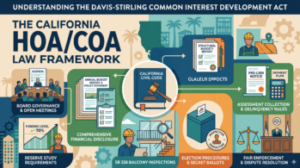
An HOA rule is unenforceable when it conflicts with federal law, conflicts with a state-specific homeowner-protection statute (in California, Davis-Stirling Civil Code Sections 4710 through 4753), was adopted without following the procedural requirements of the association’s governing documents and applicable state rule-adoption process, or is enforced selectively against some owners and not others. Boards that try to enforce such rules face fee reversal, fine refunds, and litigation exposure with attorney-fee liability under the prevailing-party provisions of most state HOA statutes. This guide walks the four categories of unenforceability for California boards specifically, plus the federal limits that apply to every HOA in the country, and closes with a 10-question board-audit checklist for surfacing probable unenforceability in your own rulebook before a homeowner does it for you.
Editorial note: this guide summarizes the most commonly cited statutes and is provided for general informational purposes. State-specific applications and any contested enforcement action should be confirmed with association counsel. Citations reflect statutory frameworks as of early 2026; subsequent amendments may shift the analysis.
What makes an HOA rule unenforceable?
An HOA rule becomes unenforceable when it falls into one of four categories: it conflicts with a federal statute (like the Fair Housing Act or the FCC OTARD rule), it violates a state-specific homeowner-protection provision (in California, the Davis-Stirling Civil Code Sections 4710 through 4753 that protect specific activities), it was adopted without following the rule-adoption procedure required by the governing documents and state law, or it is enforced selectively rather than uniformly.
Because operating rules sit beneath the recorded CC&Rs in the governing-documents hierarchy, a board testing a rule for enforceability should understand that hierarchy first; see our guide to what CC&Rs are and how they rank above bylaws and rules.
The first two categories are substantive: the rule’s content is unenforceable regardless of how cleanly the board adopted or noticed it. The second two categories are procedural: the rule’s content might be enforceable in principle, but the way the board enacted or enforced it defeats the enforcement action. Boards typically focus on substantive unenforceability when reviewing rules, and underweight procedural unenforceability, which is where most enforcement actions actually fail at challenge.
What federal limits apply to every HOA rule regardless of state?
Every HOA in the United States operates under a federal floor of homeowner protections that override any conflicting CC&R, bylaw, or board rule, and the four most commonly invoked federal protections are the Fair Housing Act, the FCC Over-the-Air Reception Devices (OTARD) Rule, the Freedom to Display the American Flag Act, and the Servicemembers Civil Relief Act.
Federal preemption means a state-law analysis that ignores the federal floor is incomplete. A rule that complies with Davis-Stirling but conflicts with the Fair Housing Act is still unenforceable, and the homeowner challenging it may have both federal and state remedies available.
How does the Fair Housing Act limit HOA rules?
The Fair Housing Act (42 U.S.C. Sections 3601 through 3631) prohibits HOAs from adopting or enforcing any rule that discriminates on the basis of race, color, religion, sex, familial status, national origin, or disability, and it requires HOAs to grant reasonable accommodations and reasonable modifications when a homeowner with a disability requests one in order to use and enjoy the dwelling.
The most common HOA-context Fair Housing Act issues involve assistance animals (boards that try to apply blanket no-pet rules to assistance animals violate the Act), parking accommodations (boards that refuse to assign accessible parking to a homeowner with a mobility impairment violate the Act), and architectural-modification requests for accessibility (ramps, grab bars, widened doorways). The right framework: any time a homeowner cites a disability as the basis for a request, the board treats it as a Fair Housing Act reasonable-accommodation analysis, not as a generic architectural-review or pet-rule application.
What does the FCC OTARD Rule protect for HOA homeowners?
The FCC’s Over-the-Air Reception Devices Rule (47 C.F.R. Section 1.4000) preempts any HOA rule that prohibits, restricts, or imposes unreasonable delay or cost on a homeowner’s installation, maintenance, or use of a satellite dish one meter or smaller in diameter, a television broadcast antenna, or a fixed wireless signal antenna, when installed in an area within the homeowner’s exclusive use or control.
Boards may regulate placement within the homeowner’s exclusive-use area for legitimate safety or historic-preservation reasons, but blanket prohibitions on satellite dishes are unenforceable. Architectural-review rules that effectively bar reception devices through delay, fee, or impossible-to-satisfy aesthetic requirements have been treated by the FCC as preempted as well.
What does the Freedom to Display the American Flag Act protect?
The Freedom to Display the American Flag Act of 2005 (Public Law 109-243, codified at 4 U.S.C. Section 5 note) prohibits any condominium association, cooperative association, or residential real estate management association from adopting or enforcing a policy that bars or restricts a member from displaying the flag of the United States on the member’s residential property, subject only to reasonable restrictions necessary to protect a substantial interest of the association.
Boards may impose size, placement, and time-of-display restrictions if they meet the substantial-interest test, but cannot ban flag display outright. State analogs (California Civil Code Section 4710 specifically) extend similar protection to the California state flag and certain noncommercial signs.
What does the Servicemembers Civil Relief Act protect for active-duty HOA members?
The Servicemembers Civil Relief Act (50 U.S.C. Section 3901 et seq.) imposes a federal floor of protections on active-duty service members and their dependents, including limits on default judgments, interest-rate caps on pre-service debts, and restrictions on foreclosure for non-payment of assessments incurred before active-duty entry.
For HOA boards, the most consequential provision is the foreclosure restriction: a board pursuing non-judicial foreclosure against an active-duty service member for pre-service-period delinquent assessments must comply with the SCRA’s procedural protections, including service-member identification through the Department of Defense database and judicial-approval requirements in many states. Boards that miss the SCRA analysis face foreclosure-defect challenges with attorney-fee exposure.
What HOA rules are unenforceable in California specifically?
California’s Davis-Stirling Common Interest Development Act enumerates a defined set of homeowner-protected activities at Civil Code Sections 4710 through 4753, and any HOA rule that prohibits or unreasonably restricts one of these protected activities is unenforceable as a matter of California law, regardless of what the CC&Rs say.
The list of Davis-Stirling-protected activities is specific and finite. Boards in California should treat the Civil Code Section 4710 through 4753 range as a defined exception list to general rule-making authority, not as a set of suggestions. For the broader statutory framework that establishes the rule-making authority Davis-Stirling then constrains, see the Davis-Stirling Act guide for California HOA and COA boards.
What activities does Davis-Stirling Civil Code Section 4710 protect?
Civil Code Section 4710 protects the display of noncommercial signs, posters, flags, and banners, plus the display of religious items on entry doors and door frames, against blanket prohibitions in CC&Rs or board rules, subject to defined size and time limitations.
Practically, boards cannot adopt a rule banning all yard signs, all flags, or all religious-item display on entry doors. Reasonable restrictions on size, location, and (for some categories) time-of-display are permitted, but the categorical ban that boards sometimes attempt in response to a contentious political season is not enforceable. The companion Section 4515 extends similar protection to peaceful assembly and the use of common-area space for member-organized meetings on association governance.
Does Davis-Stirling protect a homeowner’s right to keep a pet?
Civil Code Section 4715 grants every owner the right to keep at least one pet (typically interpreted as a cat or small dog) within the unit despite any contrary provision in the CC&Rs, subject to reasonable rules regulating the keeping of pets and to any health-and-safety restrictions the board may adopt.
The Section 4715 right is a default that the CC&Rs cannot override. The board may regulate the pet (size, leash, common-area conduct, waste removal), but cannot prohibit pet ownership entirely. The right is independent of the Fair Housing Act assistance-animal analysis, which applies regardless of the pet-rule baseline.
Can an HOA require traditional landscaping when a homeowner wants drought-tolerant plants?
Civil Code Section 4735 prohibits any provision in a governing document or board rule that requires high-water-using turf or that prohibits a homeowner from installing low-water-using plants, drought-tolerant landscaping, or synthetic grass and artificial turf in the homeowner’s separate-interest area.
Boards may regulate the appearance and installation standards for synthetic turf and drought-tolerant plantings, but cannot bar them. The standard is reasonable architectural review, not prohibition. California’s recurring drought cycles and water-conservation policy make this one of the most contested rule areas for boards that try to maintain a uniform-lawn aesthetic standard.
What does Davis-Stirling say about electric vehicle charging stations?
Civil Code Section 4745 grants every owner the right to install an electric vehicle charging station for personal use within the owner’s separate-interest area or designated parking space, despite any contrary provision in the CC&Rs, subject to reasonable architectural and electrical-safety requirements imposed by the board.
Boards may require the owner to bear installation cost, carry liability insurance covering the charging station, and meet electrical-safety standards consistent with state and local codes. Boards cannot prohibit the installation entirely or impose conditions that effectively make installation impossible.
Can an HOA prohibit clotheslines or solar drying lines?
Civil Code Section 4753 prohibits any provision in a governing document or board rule that bars a homeowner’s installation or use of a clothesline or drying rack in the homeowner’s separate-interest area, subject to reasonable restrictions for safety and aesthetics that do not significantly increase the cost or significantly decrease the efficiency of the clothesline.
The Section 4753 protection is part of California’s broader policy of removing private-association barriers to energy-conservation measures (alongside Section 4735 for landscaping and Section 4745 for EV charging). Boards that try to maintain blanket no-clothesline rules face the same unenforceability analysis that applies to the other energy-conservation protected categories.
What does Davis-Stirling Section 4360 require for rule adoption?
Civil Code Section 4360 requires the board to provide written notice to all members of any proposed operating rule change at least 28 days before the board meeting at which the board will vote on the change, with the notice describing the proposed rule and inviting member comment, and any rule adopted without following this notice procedure is unenforceable until the procedure is correctly followed.
The 28-day notice requirement is the most commonly missed procedural step in California rule-making. Boards routinely adopt operating rules at a meeting without prior member notice, or with notice that omits the rule description. Either defect makes the rule procedurally unenforceable, even when the substantive content of the rule would otherwise be valid.
How does AB-130 affect California rule enforcement in 2026?
AB-130 is California’s 2026 amendment to the Davis-Stirling Act’s fine-enforcement procedures, adding new notice, hearing, and documentation requirements that every California HOA board must follow before assessing or collecting a monetary penalty for a rule violation.
AB-130 does not change the substantive content of which rules are enforceable; it changes the procedural standard for enforcing them through fines. For the full AB-130 compliance walkthrough, including the post-AB-130 fine schedule format and the violation-notice and hearing requirements, see California AB-130 HOA Fines: A 2026 Board Compliance Guide. For the broader procedural framework for rule enforcement under Davis-Stirling, see How to Enforce HOA Rules Under the Davis-Stirling Act Without Getting Sued.
How does HOA rule unenforceability vary by state?
State-specific HOA-rule protections vary widely beyond the federal floor, with some states (California, Florida, Colorado) maintaining detailed homeowner-protection statutes and others (Texas, Arizona) leaving most rule-content questions to the governing documents and general contract-law principles.
The table below summarizes the most operationally relevant state-specific unenforceability provisions for the ten states most boards encounter through multi-state portfolios or relocation. State-by-state analysis is the area where a generic national framing breaks down fastest; boards in any specific state should confirm the current statute and case law with state-local counsel before relying on the table for policy.
| State | Statute family | Top unique unenforceability provision |
|---|---|---|
| California | Davis-Stirling Act (Civil Code Sections 4000-6150) | Sections 4710-4753 protect noncommercial signs, religious items, pets, drought-tolerant landscaping, EV charging, clotheslines, and political assembly against contrary CC&R provisions. |
| Washington | WUCIOA (RCW 64.90) | Open-meeting rules apply to all communities as of January 1, 2026 regardless of formation date; substantive WUCIOA member-rights provisions apply to all pre-existing residential communities by January 1, 2028. |
| Florida | Florida Statutes Ch. 720 (HOAs), Ch. 718 (condos) | HOA fining authority is statutorily capped, and HOA boards cannot enforce fines beyond statutory limits regardless of CC&R language; condo declaration amendments are subject to specific recording-and-vote requirements. |
| Texas | Texas Property Code Ch. 209 | Strict due-process requirements for fining (written notice, hearing, opportunity to cure); HOA must provide ledger and detailed accounting on owner request. |
| Colorado | Colorado Common Interest Ownership Act (CCIOA, C.R.S. Title 38, Article 33.3) | Member-rights provisions for political signs, drought-tolerant landscaping, and renewable-energy installations; rule-adoption procedure must follow CCIOA notice and comment requirements. |
| Arizona | Arizona Revised Statutes Title 33, Chapters 9 and 16 | Display of political signs protected within 71 days before election to 3 days after; flag display generally protected; reasonable architectural review allowed. |
| Nevada | Nevada Revised Statutes Chapter 116 | Restrictions on fine amounts, mandatory mediation before certain enforcement actions, and ombudsman oversight of common-interest-community disputes. |
| North Carolina | NC General Statutes Ch. 47F (Planned Community Act) | Limited rule-making authority absent specific declaration grant; fining authority requires specific declaration language and statutory procedural compliance. |
| Georgia | Georgia Property Owners’ Association Act (O.C.G.A. Section 44-3-220 et seq.) | Statutory opt-in regime; associations not opted in operate under common-law contract principles with narrower default fining authority. |
| Virginia | Virginia Property Owners’ Association Act (Code of Virginia Section 55.1-1800 et seq.) | Mandatory disclosure-packet content on resale, member-rights protections for solar and political signs, and procedural requirements for rule adoption. |
State citations summarize the statutory frameworks at the chapter level. Specific section requirements vary, and many states have amended their HOA statutes since 2020. Boards in any of these states should confirm current section numbers and case-law interpretation with state-local counsel before relying on the table for policy.
What procedural defects make an HOA rule unenforceable?
The four procedural defects that most commonly defeat HOA rule enforcement are failure to follow the state-required rule-adoption procedure (notice, comment, board vote), retroactive enforcement against conduct that occurred before the rule was adopted, selective enforcement against some owners but not others similarly situated, and inadequate hearing process when the enforcement action involves a monetary penalty or other significant sanction.
Procedural unenforceability is the more common defeat mechanism than substantive unenforceability, because most boards remember to check whether a rule’s content is permitted but forget to check whether the rule was adopted and enforced correctly. The four defects are independent: a rule can fail on any one of them and still be procedurally invalid even if the other three are clean.
How does rule-adoption procedure work in California?
California’s Civil Code Section 4360 requires the board to provide written notice of any proposed operating rule change to all members at least 28 days before the board meeting at which the board will vote on the change, with the notice describing the proposed rule and inviting member comment, and the board cannot adopt the rule before the 28-day notice period expires.
Boards that adopt operating rules without the 28-day notice produce procedurally defective rules. The defect can be cured by re-noticing and re-adopting, but until the cure is complete, the rule is not enforceable against any owner. Boards that try to enforce the rule during the procedural-defect window expose themselves to a Civil Code Section 5145 enforcement-action challenge.
Why is retroactive enforcement problematic?
Retroactive enforcement is the application of a newly adopted rule to conduct that occurred before the rule existed, and most state HOA frameworks treat retroactive enforcement as unenforceable on basic notice-and-fairness grounds (the homeowner had no way to comply with a rule that did not yet exist at the time of the conduct).
The cleaner pattern is to set a clear effective date for any newly adopted rule and apply the rule only to conduct on or after that date. Boards that try to use a new rule to enforce against historical conduct (a pre-rule-existence improvement, a pre-rule-existence pet, a pre-rule-existence parking arrangement) face a homeowner challenge that defeats the enforcement action without reaching the substantive content question.
What is selective enforcement, and why does it defeat HOA rules?
Selective enforcement is the enforcement of a rule against some owners but not others who are similarly situated, and it defeats the enforcement action on equal-treatment grounds in virtually every state that has considered the question, because the rule’s enforceability depends on uniform application rather than discretionary targeting.
The most common selective-enforcement defeat: the board enforces a parking restriction against the new homeowner but lets the long-time homeowner park in the same place without consequence, or enforces an architectural rule against the homeowner who challenges the board but waives it for the homeowner who is a board member’s friend. The cure is documented uniform enforcement: every violation gets the same notice, the same cure period, and the same hearing process.
How can a board audit its own rules for unenforceability?
A board can audit its own rules for probable unenforceability by running the rule set through a 10-question checklist that catches the most common substantive and procedural defects before a homeowner challenge does.
The checklist below is not a substitute for counsel review, but it is the right pre-counsel filter to identify which rules need the closest legal scrutiny and which can be tightened or rescinded by board action without further analysis.
- Does any rule directly prohibit an activity protected by Davis-Stirling Civil Code Sections 4710 through 4753 (signs, religious items, pets, drought-tolerant landscaping, EV charging, clotheslines, peaceful assembly)?
- Does any rule effectively prohibit a federally protected activity through delay, cost, or impossible conditions (satellite dishes under FCC OTARD, American flag display, assistance animals under FHA)?
- Does any rule discriminate facially or in effect on the basis of a Fair Housing Act protected class (race, color, religion, sex, national origin, familial status, disability)?
- Was each operating rule adopted with the Civil Code Section 4360 28-day member notice, or is there a paper trail showing the notice was sent and the comment period observed?
- Does the association have a written fine schedule that complies with AB-130’s post-2026 notice and documentation requirements, and is the fine schedule cross-referenced in the violation-notice template?
- Has any rule been applied retroactively to conduct that pre-dates the rule’s adoption date?
- Is there a record of consistent enforcement across all owners who have violated the rule, or has the board waived enforcement for specific owners?
- Does the disciplinary-hearing process for fines include the Civil Code Section 5855 ten-day pre-hearing notice and the fifteen-day written-decision delivery?
- Does the rule conflict with the CC&Rs themselves (operating rules cannot expand or contradict the recorded declaration), or is the rule consistent with the governing-document hierarchy?
- Has the rule set been reviewed by association counsel within the last 24 months, especially in light of the 2026 AB-130 amendments and any post-2024 state-specific HOA-rule legislation?
Rules that fail one or more of these checks should be flagged for counsel review. Boards that catch the failures in a self-audit avoid the more expensive outcome of catching them through a contested enforcement action.
Frequently asked questions about unenforceable HOA rules
Can a homeowner refuse to pay a fine for an unenforceable rule?
A homeowner can challenge the fine through the association’s internal dispute resolution process (in California, Civil Code Section 5915 IDR or Section 5925 ADR) and ultimately through litigation, but unilaterally refusing to pay without first invoking the IDR process exposes the homeowner to lien and collection risk. The cleaner path: pay the fine under protest in writing, then immediately invoke IDR to recover the payment if the rule is found unenforceable.
Does an unenforceable rule become enforceable if the board re-adopts it correctly?
An unenforceable rule that is substantively valid but procedurally defective (adopted without 28-day notice, for example) can be cured by re-noticing and re-adopting with full procedural compliance, and the rule then becomes enforceable on the post-cure adoption date going forward (never retroactively). A rule that is substantively unenforceable (conflicts with Davis-Stirling Sections 4710-4753 or with federal law) cannot be cured by re-adoption; the substantive defect persists regardless of procedural compliance.
Can the CC&Rs make an unenforceable rule enforceable?
The CC&Rs cannot make enforceable what state or federal law makes unenforceable. The Davis-Stirling Sections 4710-4753 protections override contrary CC&R provisions by their express statutory terms, and the federal Fair Housing Act preempts contrary CC&R provisions through federal supremacy. Boards relying on a “but the CC&Rs say so” defense for a substantively unenforceable rule consistently lose at IDR and in litigation.
What is the homeowner’s remedy if the board enforces an unenforceable rule?
The homeowner’s remedies typically include reversal of the fine or other enforcement action, refund of any amount paid, and (under most state HOA statutes) recovery of attorney fees and costs incurred in challenging the enforcement. California’s Civil Code Section 5975 includes a prevailing-party attorney-fee provision for enforcement actions, which is one of the strongest incentives for boards to audit rules before attempting to enforce them.
Does an HOA’s failure to enforce a rule consistently make the rule unenforceable going forward?
Consistent non-enforcement of a rule over time can support a homeowner’s selective-enforcement defense and, in some jurisdictions, a waiver or estoppel defense against future enforcement. The cure is documented uniform enforcement starting from a defined effective date, paired with member notice that the association will be enforcing the rule going forward.
Can a board adopt a rule that the CC&Rs do not authorize?
A board’s rule-making authority is limited to the scope granted by the CC&Rs and applicable state law. Operating rules cannot expand the board’s authority beyond the recorded declaration. Rules that purport to grant the board new powers (the power to impose fines for a category the CC&Rs do not authorize, the power to restrict a use the CC&Rs explicitly permit) are unenforceable on governing-document-hierarchy grounds even when adopted with full procedural compliance.
How often should a board audit its rules for unenforceability?
A board should audit its complete rule set at least every three years, and more often when significant state legislation affects HOA rule-making authority (California boards specifically should re-audit after the 2026 AB-130 amendments take effect). Boards that audit on a defined cadence catch unenforceable rules before they generate contested enforcement actions.
Are short-term rental restrictions enforceable in California HOAs?
Short-term rental restrictions in California HOAs are generally enforceable when they are clearly stated in the CC&Rs or in a Civil Code Section 4360 operating rule adopted with proper notice, but the enforceability has been narrowed in specific contexts by recent California legislation and case law (including the interaction with Civil Code Section 4740 protections for existing rental rights). Boards considering or enforcing short-term rental restrictions should confirm the current statutory and case-law landscape with counsel.
How does AMLO help California boards audit and update HOA rules?
AMLO Community Management runs rule-audit and rule-adoption work as a defined operational engagement for California HOA and condominium boards, integrating the Davis-Stirling substantive-protection analysis (Civil Code Sections 4710 through 4753), the federal-preemption analysis (Fair Housing Act, OTARD, flag display, SCRA), the Section 4360 procedural compliance work, and the 2026 AB-130 fine-enforcement standard into a single deliverable the board can present to counsel for final review.
For boards working through a contested rule, a board-initiated rule audit, or a post-AB-130 fine-schedule update, AMLO coordinates the documentation trail, the Section 4360 member-notice cadence, and the post-adoption enforcement workflow so the board is operating from a defensible procedural baseline. AMLO serves California HOA and COA boards across the state with deep concentrations in the Los Angeles metro and Greater Los Angeles area, with the same Davis-Stirling specialist team handling the full California portfolio.
For California-specific board questions about contested rules, AB-130 compliance, or proactive rule-audit work, contact AMLO through the contact page for an intake call that walks the rule set through the chapter-by-chapter Davis-Stirling compliance review.