AB-130 caps most California HOA fines at the lesser of the amount in the association’s adopted fine schedule or $100 per violation, except as specified in the statute. The Governor signed it on June 30, 2025, and it took effect immediately. That single number is the change most boards have to act on. A schedule that let the board levy a $250 or $500 penalty for a common violation now runs into a statutory ceiling.
AB-130 is a 2025 housing budget trailer bill (Chapter 22 of the 2025 statutes). Most of it deals with housing: accessory dwelling units, zoning, CEQA streamlining, foreclosure servicing, seismic retrofit. The HOA fine changes are a small rider inside that larger bill. They amend the Davis-Stirling Act’s member-discipline provisions at Civil Code §5850 and §5855. This guide covers what those changes are, what stayed the same, and what a California board should update before it issues its next fine.
This article is procedural guidance, not legal advice. AB-130’s fine cap applies “except as specified,” meaning the statute carves out exceptions. Confirm how the cap and its exceptions apply to a specific violation with association counsel before changing policy.
What is California AB-130 and how does it change HOA fines?
AB-130 is a 2025 California budget trailer bill, signed June 30, 2025, that amended the Davis-Stirling Act to cap most HOA monetary fines at the lesser of the association’s adopted fine schedule or $100 per violation, except as specified. It also required an opportunity to cure before the discipline meeting, made an agreed written resolution judicially enforceable, and shortened the written-decision window from 15 days to 14 days.
The fine cap is the headline. Before AB-130, an association set its own penalty amounts in a board-adopted schedule and could fine up to those amounts. AB-130 keeps the schedule requirement but adds a statutory ceiling on top of it: the penalty is the lesser of the scheduled amount or $100 per violation, with exceptions the statute specifies. Boards that built escalating schedules topping out at several hundred dollars have to reconcile them with the cap.
What did AB-130 change about Davis-Stirling fine enforcement?
AB-130 made four changes to the Davis-Stirling discipline process: it capped most monetary fines at the lesser of the adopted schedule or $100 per violation; it required the board to give the member an opportunity to cure the violation before the discipline meeting; it made a signed written resolution between the board and member judicially enforceable; and it shortened the written-decision notice from 15 days to 14 days.
- A $100-per-violation cap. The monetary penalty is the lesser of the amount in the board-adopted schedule or $100 per violation, except as specified in the statute (Civil Code §5850). This is the change with the widest reach.
- An opportunity to cure before the meeting. The board must give the member a chance to correct the violation before the meeting at which discipline is considered or imposed (Civil Code §5855).
- A binding written resolution. If the board and the member reach agreement after the discipline meeting, the board drafts a written resolution. A signed resolution, under a procedure not in conflict with law or the governing documents, binds the association and is judicially enforceable.
- A 14-day decision window. The board must notify the member of a disciplinary decision within 14 days of the meeting, down from the prior 15-day window (Civil Code §5855).
The table below sets the pre-AB-130 baseline against the current rule.
| Step | Davis-Stirling before AB-130 | After AB-130 |
|---|---|---|
| Fine amount | Up to the amount in the board-adopted schedule; no statutory dollar ceiling | The lesser of the scheduled amount or $100 per violation, except as specified (Civil Code §5850) |
| Opportunity to cure | Not separately required before the discipline meeting | Board must give the member a chance to cure before the meeting to consider or impose discipline (Civil Code §5855) |
| Pre-meeting notice | At least 10 days before the discipline meeting (Civil Code §5855) | Unchanged: at least 10 days |
| Written decision window | Within 15 days of the meeting (Civil Code §5855) | Within 14 days of the meeting |
| Agreed resolution | No statutory enforceable-resolution mechanism | Signed written resolution binds the association and is judicially enforceable |
| Collection | Non-assessment fines cannot be liened against the unit (Civil Code §5725) | Unchanged: non-assessment fines cannot be liened (Civil Code §5725) |
The schedule itself did not go away. Boards still adopt a schedule of monetary penalties, still distribute it, and still cannot fine above it. AB-130 adds a hard ceiling on top of that schedule and tightens two procedural steps around the discipline meeting.
How do California boards enforce fines under AB-130?
California boards impose a fine under AB-130 by adopting and distributing a current fine schedule, giving the member an opportunity to cure, sending at least 10 days’ written notice of the discipline meeting, holding the meeting, and notifying the member of the decision in writing within 14 days, with any monetary penalty capped at the lesser of the scheduled amount or $100 per violation.
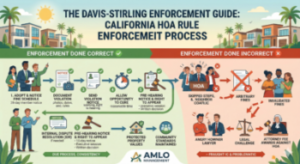
The sequence, with the steps AB-130 changed marked:
- Adopt and distribute the fine schedule. The board adopts a schedule of monetary penalties and distributes it to members with the annual policy statement (Civil Code §5310). The scheduled amounts now sit under the $100-per-violation cap.
- Give an opportunity to cure. Before the discipline meeting, give the member a chance to correct the violation. This step is new under AB-130.
- Send notice of the discipline meeting. The member gets at least 10 days’ written notice before the meeting (Civil Code §5855). This window is unchanged.
- Hold the meeting. The board considers the violation and the member’s response. The member may request that the meeting be held in executive session.
- Notify the member of the decision. If the board imposes discipline, it notifies the member in writing within 14 days of the meeting (Civil Code §5855). AB-130 shortened this from 15 days.
- Apply the cap and collect. The monetary penalty is the lesser of the scheduled amount or $100 per violation, except as specified. The fine is a personal obligation of the member; under Civil Code §5725, a non-assessment fine cannot be liened against the unit.
If the board and the member reach agreement at or after the meeting, the board can record it in a written resolution. Signed by both sides under a compliant procedure, that resolution binds the association and is enforceable in court.
What does an AB-130-compliant fine schedule look like?
An AB-130-compliant fine schedule keeps every monetary penalty at or below the lesser of the board’s set amount or $100 per violation, cites the rule each fine enforces, notes an opportunity to cure where the violation is curable, and is adopted by the board and distributed annually with the annual policy statement under Civil Code §5310.
A schedule that holds up under AB-130 has these elements:
- Amounts at or under the cap. Each monetary penalty is capped at the lesser of the amount the board sets or $100 per violation, except where the statute specifies otherwise. Schedules that topped out at $250 or $500 per violation have to be reconciled with the ceiling.
- Rule citation. Each line references the specific CC&R section or operating rule it enforces.
- Opportunity to cure. Where a violation is curable, the schedule notes that the member gets a chance to correct it before discipline, consistent with AB-130.
- Reasonable penalties. Penalties must be reasonable in relation to the violation, a standard Davis-Stirling already imposed and AB-130 does not relax.
- Annual adoption and distribution. The board re-adopts the schedule and distributes it with the annual policy statement under Civil Code §5310.
Boards running a schedule written before July 2025 should treat reconciliation with the $100 cap as the first task. Outside the exceptions the statute specifies, a monetary penalty cannot exceed $100 per violation, so any higher amount on the schedule is not collectable above the cap.
What happens if a board violates AB-130?
When a board imposes a fine that exceeds the AB-130 cap or skips a required step, the member can challenge it through Internal Dispute Resolution (Civil Code §5915), Alternative Dispute Resolution (Civil Code §5925 and following), or litigation, and the fine can be reduced to the cap or voided to the extent it does not comply.
- The fine is reduced or voided. Outside the statute’s exceptions, a penalty above $100 per violation is not enforceable above the cap. A fine issued without the required cure opportunity or notice can be thrown out entirely.
- Attorney’s fees exposure. Civil Code §5975(c) awards reasonable attorney’s fees to the prevailing party in an action to enforce the governing documents. A board that loses on the fine can end up paying the member’s fees and its own.
- Insurance scrutiny. A pattern of defective enforcement can draw directors-and-officers insurance review.
- Reputational cost. Fine disputes surface at annual meetings and stay on the association’s record.
The math favors compliance. A member who voids a fine on statutory grounds can recover several thousand dollars in fees over a penalty that AB-130 now caps at $100 in the first place.
When should a board bring in counsel or a management company?
A board should consult counsel when reconciling its fine schedule with the AB-130 cap, when a fine is contested in writing, when a violation touches a protected category such as disability accommodation or fair housing, and when it revises its notice and hearing templates to add the opportunity-to-cure step and the 14-day decision window.
Routine, uncontested fines within the cap do not need per-fine counsel review. The policy work does. Reconciling the schedule to the $100 ceiling, rewriting the notice and decision templates, and building the cure step into the process is a one-time review that protects every fine after it.
A management company carries the procedural load AB-130 tightened: tracking the cure window and the 10-day notice, keeping the meeting and decision on the 14-day clock, applying the cap on every penalty, and distributing the schedule with the annual policy statement. Self-managed boards can do this, but AB-130 leaves less room for a missed step.
If your association is in California and you are reconciling your enforcement policy with AB-130, AMLO’s California team handles this kind of rebuild as part of onboarding. Reach out via the contact page or our California locations page.
Related reading
- The Davis-Stirling Act: A Complete Guide for California HOA and COA Boards. The parent statute AB-130 amends.
- HOA Rule Enforcement Under Davis-Stirling. The enforcement context AB-130’s fine changes sit inside.