Ask most HOA board members what their association’s reserve fund balance is, and they can tell you. Ask them whether that balance is adequate, and most will pause.
The reserve fund balance — the number that appears on the monthly financial statement — tells you how much money is in the account right now. It tells you almost nothing about whether that amount is enough to cover what the account exists to pay for. A reserve fund with $400,000 in it could be fully funded, critically underfunded, or anywhere in between, depending on what the community’s major components cost to replace and when those replacements are coming due.
Understanding the reserve fund — not just its balance, but its purpose, its funding requirements, and the consequences of getting it wrong — is one of the most important things an HOA board member can do. This guide covers everything a board member needs to know about reserve funds, reserve studies, funding standards, and what happens when reserves fall short.
What Is an HOA Reserve Fund?
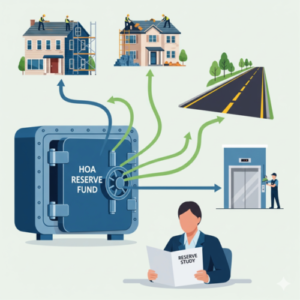
The reserve fund is a dedicated savings account — separate from the association’s operating account — that exists for one purpose: to pay for the repair and replacement of major common area components when they reach the end of their useful life.
Every community has major components that wear out over time and will eventually need to be replaced. Roofs. Paving and parking lots. Pool equipment, decking, and plaster. Exterior paint or siding. Elevators. HVAC systems for common areas. Irrigation systems. Concrete flatwork. Perimeter fencing. These are not operating expenses — they don’t happen every year, and their costs are too large to absorb in the annual operating budget. They are capital expenses, and the reserve fund is how responsible associations plan for them.
The theory is straightforward: if a roof that serves 80 units costs $400,000 to replace and has a 25-year useful life, the association should be setting aside $16,000 per year — roughly $200 per unit per year — so that when the roof needs replacing, the money is available. An association that doesn’t fund its reserves consistently is borrowing from its future self, and the debt comes due in the form of a special assessment.
What Does the Reserve Fund Cover?
The reserve fund covers major components — physical assets that the association is responsible for maintaining, whose replacement cost exceeds a meaningful threshold, and whose useful life is finite.
Most reserve studies include components in the following categories: roofing systems (shingles, membrane, flashing); paving and parking (asphalt, concrete, striping, curbs); pool and spa (replastering, equipment, decking, fencing, heaters); exterior paint and siding (including wood repair and preparation); building envelope (windows, doors, siding, waterproofing); elevators (equipment, cab interiors, modernization); HVAC and mechanical (common area heating and cooling systems, boilers); landscaping infrastructure (irrigation systems, lighting, hardscape); amenity facilities (clubhouse furniture and equipment, fitness equipment, courts); signage and access systems (gates, entry systems, directory signs); and drainage and utility infrastructure.
What the reserve fund does not cover is operating expenses — routine maintenance, landscaping service, management fees, utilities, insurance premiums, and similar recurring costs. These belong in the operating budget. The reserve fund is specifically for capital replacement.
The distinction matters because boards sometimes blur the line — using reserve funds to cover operating shortfalls, or treating reserve contributions as discretionary budget items that can be reduced when the operating budget is tight. Both practices are problematic, and under WUCIOA in Washington, transfers out of reserve accounts require documented authorization and are subject to specific governance requirements.
What Is a Reserve Study?
A reserve study is a professional analysis of the association’s major components — their current condition, their estimated remaining useful life, their projected replacement cost, and the annual funding contribution required to maintain adequate reserves. It is the financial planning document that answers the question every board needs to answer: how much should we be putting into reserves each year?
A full reserve study has two parts. The physical analysis involves an on-site inspection of all major components, assessment of their current condition, and estimation of their remaining useful life and replacement cost. The financial analysis uses the physical data to calculate the current reserve balance, the fully funded target, the current funding percentage, and the recommended annual contribution under one or more funding methodologies.
Reserve studies are prepared by professional reserve specialists — typically engineers or certified reserve planners with specific training in component analysis and reserve fund mathematics. They are not a DIY project for the board treasurer, and they should not be delegated to the management company unless the management company employs qualified reserve specialists.
How Often Is a Reserve Study Required?
Under WUCIOA in Washington, the reserve study must be updated annually. The annual update does not require a new full on-site inspection every year — an update study can be prepared using the prior year’s physical analysis updated for known changes and inflation adjustments — but a full inspection should be conducted periodically to ensure the physical assumptions remain accurate.
Under California’s Davis-Stirling Act, a full reserve study with an on-site inspection is required at least every three years. In the intervening years, an update study (without a new on-site inspection) must be completed. The reserve study findings must be disclosed to members in the Annual Budget Report.
For communities that have recently completed an SB 326 balcony inspection in California, the inspection findings should be incorporated into the reserve study — the inspector’s assessment of remaining useful life and replacement cost for elevated elements is the most reliable input available for those components.
Understanding Reserve Funding Levels
The reserve study tells you how much you should have in reserves at any given point. The percent funded metric tells you how close your actual balance is to that target.
Percent funded is expressed as a ratio: your current reserve balance divided by the fully funded balance (the amount that would be in the reserve fund if every component had been funded perfectly from day one). A community that is 100% funded has exactly as much in reserves as a theoretically perfect funding schedule would require. A community that is 50% funded has half of what it should have.
What Does “Adequate” Reserve Funding Actually Mean?
Industry standards and lender guidelines generally consider reserves adequate at 70% funded or above. Below 70% is considered underfunded. Below 30% is considered severely underfunded.
These thresholds matter practically, not just philosophically. Fannie Mae and Freddie Mac guidelines for condominium financing require that the association not be “critically underfunded” — which they define as having reserves less than 10% of the association’s annual budget. Many lenders apply stricter standards and will not lend on units in condominium associations that are below 70% funded. An underfunded reserve account can make units harder to sell, drive down property values, and complicate refinancing for existing owners — even if no special assessment has been levied yet.
Reserve Funding Methodologies
There are three primary methodologies for calculating the recommended annual reserve contribution.
The percent funded method targets a specific funding percentage — typically 70% to 100% — and calculates the annual contribution needed to maintain or reach that percentage over time. It produces a stable, long-term funding plan that keeps the reserve account at an adequate level through the replacement cycle.
The threshold method establishes a minimum reserve balance — expressed as a dollar amount or percentage — and calculates the contribution needed to maintain that minimum. It is simpler than the percent funded method but less precise about long-term funding adequacy.
The cash flow method projects annual inflows (contributions) and outflows (replacements) over a 20 to 30 year period and calculates the contribution needed to ensure the account never goes negative — meaning the fund always has enough to cover replacements as they come due. It can be more flexible than the percent funded method but requires careful management to avoid underfunding in the near term.
Your reserve specialist will recommend a methodology appropriate to your community’s situation. The choice matters less than the discipline of following the recommendation — whatever methodology the study uses, the recommended contribution should be funded in full in the annual budget.
The Real Cost of Underfunding Reserves
Reserve underfunding has a compounding cost that most boards don’t fully appreciate when they vote to reduce contributions.
The direct cost is the funding gap itself. Every year the association contributes less than the reserve study recommends, the gap between the current balance and the fully funded target widens. When major components reach the end of their useful life, that gap becomes a bill — in the form of a special assessment, a loan, or deferred replacement that accelerates deterioration.
The indirect cost is the compounding effect of deferred replacement. Major components that are not replaced on schedule don’t stop deteriorating — they deteriorate faster. A roof that should have been replaced at year 20 and is still in service at year 25 has not simply deferred the replacement cost. It has generated five years of additional damage — to the substrate, the insulation, the interior finishes below — that wasn’t in the original replacement cost estimate. The $400,000 roof replacement becomes a $500,000 roof and ceiling repair project.
The financial cost to individual owners is significant. A special assessment for a major capital project — roof replacement, paving, pool renovation — can easily reach $5,000 to $15,000 per unit in a mid-sized condominium. For an owner on a fixed income or with limited liquid savings, that is a genuine hardship. For an owner trying to sell their unit, a pending or recently levied special assessment is a material disclosure that affects pricing and buyer willingness.
The reputational cost to the board is real and lasting. Boards that levy special assessments — particularly when the underlying cause is years of deferred reserve funding by prior boards — face homeowner anger that is difficult to defuse even with transparent communication. The special assessment is the visible symptom; the underfunding is the disease, and it typically developed over years of decisions that each seemed reasonable in isolation.
Reserve Fund Investment — Rules and Considerations
Reserve funds represent significant accumulated savings that can and should be invested to earn a return. At the same time, reserve funds are not investment accounts — they serve a specific purpose (paying for capital replacements on a defined schedule), and investment decisions must prioritize capital preservation and liquidity over yield.
Under WUCIOA in Washington, reserve funds may be invested subject to specific statutory criteria. The investment policy must be consistent with the board’s fiduciary duties, and the board must maintain a documented investment policy if reserves are invested.
Under California’s Davis-Stirling Act, the board has investment authority for reserve funds but must exercise that authority prudently. California associations often use CDARS (Certificate of Deposit Account Registry Service) arrangements or similar structures that provide FDIC insurance on reserve balances above the standard $250,000 per-institution limit.
Common reserve investment vehicles include money market accounts, certificates of deposit with laddered maturities (so that funds are available as replacement projects come due), and short-term Treasury securities. Equity investments — stocks, stock mutual funds — are generally inappropriate for reserve funds because of volatility risk.
The board should review the reserve fund investment policy annually and confirm that the maturity schedule of any certificates of deposit aligns with projected replacement project timing. A CD that matures after a major replacement project is scheduled is not a useful investment — it creates a cash flow problem at exactly the wrong moment.
What Happens When a Community Inherits Underfunded Reserves
Many HOA boards take over communities where reserve underfunding has accumulated over years or decades under prior board leadership. This is one of the most difficult financial situations a board faces — not because the solution is complicated, but because the path to adequacy requires honest communication with homeowners about a problem the current board didn’t create.
The first step is to commission a current reserve study if one hasn’t been done recently. The study will quantify the underfunding — expressing it as a percent funded figure, a dollar gap, and a recommended contribution to begin closing the gap. That number is the starting point for the conversation with homeowners.
The second step is to develop a funding plan. Depending on the severity of the underfunding and the timing of upcoming major replacements, the plan might involve a phased assessment increase over several years, a one-time special assessment to recapitalize the reserve fund, or a combination of both. In some cases, an association loan — borrowed against future assessment revenue — provides a way to fund an urgent replacement project while spreading the cost over multiple years.
The third step is transparent communication. Homeowners who understand the history — that the reserve fund was underfunded over many years, that the current board is committed to correcting it, and that the funding plan is based on a professional reserve study — respond much better than homeowners who receive a surprise assessment increase with no explanation.
Reserve Fund Red Flags — What to Watch For
Reserve balance that never grows despite consistent contributions. If the reserve fund balance is flat year over year despite regular contributions, the contributions are likely being used to fund operating shortfalls through unauthorized transfers. Review the reserve account transaction history for any transfers to the operating account.
Reserve study that hasn’t been updated in more than three years. An outdated reserve study uses stale replacement cost estimates and may have missed components that have been added or removed. California requires an update study every year and a full study every three years. Washington requires an annual update. An association managing reserves without a current study is flying blind.
Reserve contributions that are consistently less than the study recommendation. This is the most common and most consequential red flag. If the board has been funding reserves at 60% or 70% of the recommended contribution for several years, the funding gap is growing every year. Quantify it and address it.
Reserve fund investments that are inappropriate for the timeline. A reserve fund invested in long-term bonds or equity securities — especially when major replacement projects are approaching — creates cash flow risk. Review the investment portfolio against the projected replacement schedule.
Transfers from reserves to operating without board authorization and documentation. Under WUCIOA in Washington, reserve transfers require two signatures and documented authorization. Under Davis-Stirling in California, transfers from reserve to operating accounts require a board vote, a written repayment plan, and member notification. Undocumented or unauthorized transfers are a governance and financial control failure.
How AmLo Management Handles Reserve Fund Oversight
Reserve fund management is one of the services where the quality of the management company matters most — and where the difference between careful and careless management has the most significant long-term financial consequences for the community.
AmLo Management coordinates annual reserve study updates for every community we manage, ensures that reserve study recommendations are incorporated into the annual budget as a non-negotiable line item, reviews reserve fund investment policies annually, requires documented authorization for all reserve transfers, and reports reserve fund balance and funding percentage to the board at every meeting.
We work with qualified reserve specialists and ensure that California communities meet their Davis-Stirling reserve study obligations and that Washington communities meet their WUCIOA annual update requirements. For California condominium clients, we track SB 326 inspection schedules and ensure that inspection findings inform reserve study updates.
When we take on communities with underfunded reserves — which is more common than boards expect when they transition from prior management — we develop a transparent funding plan, communicate it clearly to the board, and support the board in communicating it to homeowners.
If your association’s reserve fund situation is unclear — whether the balance is adequate, whether the reserve study is current, or whether contributions have been matching the study’s recommendations — contact AmLo Management for a conversation about where things stand and what it would take to get on track.
Disclaimer: This post is provided for general informational purposes only and does not constitute legal advice or financial advice. HOA boards should consult with qualified reserve specialists, financial professionals, and legal counsel regarding their specific reserve fund obligations. Statutory requirements referenced reflect Washington and California law as understood in early 2026.