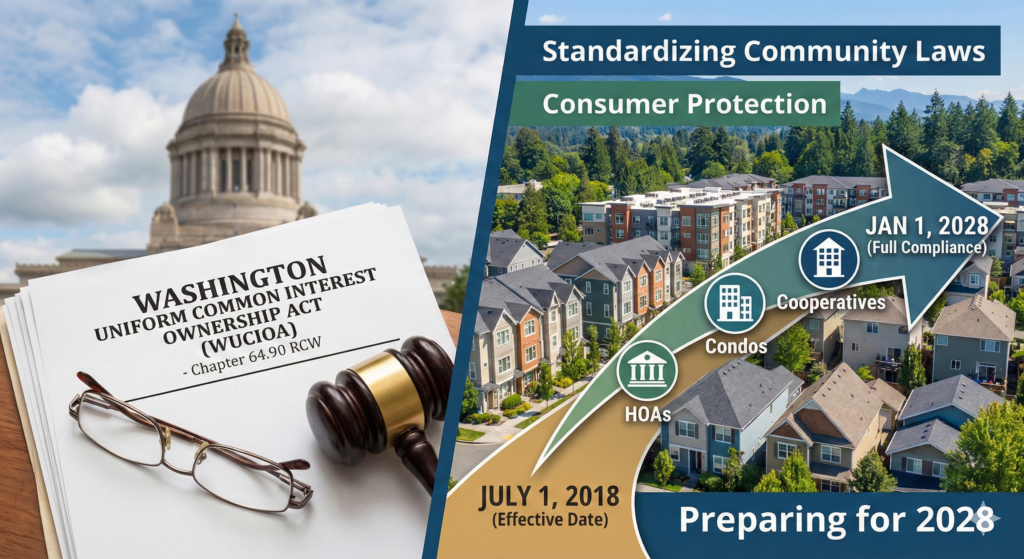
What is WUCIOA and when does it apply to my Washington HOA?
WUCIOA, the Washington Uniform Common Interest Ownership Act (RCW 64.90), is the 2018 statute that governs all Washington common interest communities.
It applies to your HOA either from formation (if created on or after July 1, 2018), through statutory phase-in for pre-existing communities (open meeting rules effective January 1, 2026; full applicability by January 1, 2028), or through formal opt-in by member vote under RCW 64.90.080. WUCIOA replaces RCW 64.38 for new and opted-in HOAs and progressively supplants RCW 64.34 for condominium associations created between 1990 and 2018.
If you serve on the board of a homeowners association or condominium community in Washington State, one law is changing virtually everything about how your community operates: the Washington Uniform Common Interest Ownership Act, widely known as WUCIOA (RCW 64.90).
Whether your community was built in 1975 or 2022, WUCIOA applies to you, or will apply by January 1, 2028 at the latest. At AmLo Community Management, we help boards across Washington State stay ahead of every legislative change. This guide covers what WUCIOA is, why it matters, what it specifically requires, and what your board needs to do today.
What is WUCIOA (RCW 64.90 Explained)
WUCIOA (the Washington Uniform Common Interest Ownership Act, codified as RCW 64.90) is Washington State’s single statute governing all common interest communities.
That means condominiums, planned unit developments (PUDs), and HOAs all fall under the same law.
Before WUCIOA, Washington communities were governed by three separate and inconsistent statutes, depending on when and how they were formed:
- RCW 64.32, The Horizontal Regimes Act (1963), for older condominiums
- RCW 64.34, The Condominium Act (1989), for newer condos
- RCW 64.38, The Homeowners’ Associations Act (1995), for HOAs
Each of these statutes was limited (less than 40,000 words combined) and left enormous gaps in governance standards. WUCIOA, first adopted in 2018 via SB6175, contains more than 65,000 words of precise, prescriptive requirements covering elections, reserve funds, open meetings, insurance, enforcement procedures, and much more.
Two major amendments have followed: SB5796 (2024) added over a dozen new sections, and SB5129 (2025) further expanded and refined the law. As of early 2026, WUCIOA is over 67,000 words and 120 sections, and it continues to grow.
Does WUCIOA apply to my HOA or Condo Association?
Almost certainly yes, if your community includes residential units.
Here is how applicability breaks down under current law (as updated by SB5129 in 2025):
- All residential condominiums are subject to WUCIOA, regardless of when they were formed.
- HOAs with more than 50 homes are fully subject to WUCIOA.
- HOAs with 50 or fewer homes assessed more than ~$1,000/year per home are fully subject to WUCIOA.
- HOAs with 50 or fewer homes assessed less than ~$1,000/year per home may only be subject to certain portions of WUCIOA. (SB5129 raised this threshold from the previous 12-unit/$300 limit.)
- Commercial-only condominiums are generally exempt from most provisions.
If you are unsure whether your association qualifies for any exception, the safest course is to assume full WUCIOA applicability and consult with a Washington State community association attorney.
What are the key WUCIOA requirements every board member must understand?
WUCIOA is far more detailed and prescriptive than any prior Washington community association law.
Below are the areas that most directly affect how your board operates day to day.
1. Open Meeting Requirements (Effective January 1, 2026)
- All board meetings must be open to unit owners.
- Owners have the right to speak at every meeting, before board discussion or votes.
- Executive (closed) sessions are permitted but must occur within an open meeting and may only address a short list of confidential topics: pending litigation, personnel matters, delinquency collections, contracts under negotiation, and a few others.
- Meetings must be noticed at least 14 days in advance, or on a formally published annual schedule.
- All materials provided to directors before a meeting must also be made available to owners before that meeting.
- Electronic meetings (Zoom, Teams, etc.) are allowed but must include a telephone dial-in option.
- Persons who disrupt a meeting may be warned and removed.
2. Election and Voting Standards
WUCIOA’s election requirements are among its most significant departures from prior law, and the 2024 SB5796 amendments made them even more specific:
- Secret ballots are mandatory for board elections and for votes on amendments to governing documents.
- Incumbent board members and candidates are prohibited from accessing ballots at any point before they are opened, counted, and recorded at the meeting.
- Ballots must be counted at the meeting called for that purpose, with the tally recorded in the minutes.
- Associations must take reasonable measures to verify voter identity for electronic participation and to confirm ballot/proxy authenticity.
- Voting rights cannot be suspended under any circumstances.
- Votes allocated to units owned by the association must be cast proportionally to the outcome. They cannot change the result.
- Election notices must disclose the number of positions open, qualification requirements, and the nomination process.
3. Board Composition Rules
- Boards must have at least three directors.
- No more than one-third of board positions may be appointed at any time. At least two-thirds must be elected by unit owners.
- Conflict of interest and indemnification standards from RCW 24.06 apply to all board members.
- A director who becomes delinquent in assessments may be removed, but owners have the right to immediately elect a successor.
- Enforcement must not be arbitrary or capricious. Consistent standards must be applied.
4. Reserve Funds and Reserve Studies
WUCIOA codifies reserve fund governance in precise terms that go well beyond what most older governing documents require:
- The board must maintain direct control over all reserve funds.
- Reserve studies must be updated annually.
- Studies must include all components whose replacement cost exceeds 1% of the annual budget.
- Studies must express reserve surplus or deficit on a per-unit basis.
- Transfers out of reserve accounts require two signatures and detailed supporting documentation.
- Reserve funds may now be invested, subject to specific statutory criteria.
- Budgets must disclose any planned reserve borrowing.
5. Accounting and Audit Requirements
- All community associations must use accrual-based accounting.
- Annual audits are required and cannot be waived by member vote, except for associations with annual budgets under $50,000.
- All dollar thresholds in the statute adjust with inflation over time.
6. Rules, Fines, and Enforcement
- Creating, amending, or repealing any rule requires two separate advance notices to owners.
- A formal fine schedule must exist and be properly noticed before any fines can be imposed.
- Creating or changing a fine schedule requires the same double-notice process as rule changes.
- The board has explicit discretion to stay (pause) enforcement, but enforcement must remain consistent.
7. Owner Rights and Records Access
- Records disclosures must be provided within 10 days (21 days maximum) of an owner’s written request.
- Owners may opt their email addresses out of records disclosures.
- Political signs may not be banned. Only reasonable rules on size and placement are permissible.
- Flagpoles in limited common elements and units cannot be unreasonably prohibited.
- Storage of compost, recycling, and garbage receptacles cannot be unreasonably prohibited.
- Owners may formally request that the board evaluate and remove unlawful restrictions from governing documents.
- Associations must accept at least one form of assessment payment at no charge to the owner.
8. Insurance Requirements
Under WUCIOA, master property insurance must cover units, and unless the declaration explicitly states otherwise, must also cover all improvements and betterments made to units by owners. This is a meaningful departure from prior law that may require many communities to update their insurance policies before the 2028 deadline.
Why do most Washington HOA and condo governing documents need a restatement?
One of the most consequential (and often overlooked) implications of WUCIOA is its effect on your existing governing documents.
Most communities formed before 2018 have declarations and bylaws written under prior law. When your governing documents conflict with WUCIOA, the statute wins. Automatically.
A governing document restatement (formally called an amendment and restatement) produces a single, updated version of your declaration and bylaws that is consistent with RCW 64.90 and reflects your community’s current reality. Adopting RCW 64.90 through a restatement requires a 67% affirmative vote of members.
The benefits of completing a restatement before the 2028 deadline include:
- Eliminating conflicts between outdated provisions and current Washington law
- Incorporating governance best practices refined over years of community association experience
- Cleaning up decades of amendments that have produced contradictory or unenforceable language
- Codifying community-specific provisions that reflect how your neighborhood actually operates
- Reducing board liability by establishing clear, legally sound procedures
Important: Restatements are not DIY projects. They require professional guidance, legal review, and meaningful owner participation, including volunteers willing to review substantial documentation. Starting early is not optional. A 67% supermajority vote is difficult to achieve on a compressed timeline.
What WUCIOA compliance deadlines must your board not miss?
WUCIOA has two compliance deadlines every Washington board must track: January 1, 2026 for open meeting and member-rights provisions, and January 1, 2028 for full applicability of governance, financial reporting, and reserve requirements to all pre-existing communities.
January 1, 2026: Open Meeting Requirements (ALREADY IN EFFECT)
Open meeting standards under RCW 64.90.445 now apply to all Washington community associations. If your board has not yet implemented compliant open meeting practices, you are already operating outside the law. This is not a future deadline. It has passed.
January 1, 2028: Full WUCIOA Compliance Required
All residential community associations in Washington State must be in full compliance with RCW 64.90 by this date. Pre-existing communities governed by RCW 64.32, 64.34, or 64.38 must transition entirely to WUCIOA standards.
2028 may feel distant, but governing document restatements that require a 67% member vote take significant time to plan, draft, notice, and execute. Boards that begin in 2027 will likely run out of time. The window to act is now.
WUCIOA Reference: Applicability, Comparison, and Legislative Timeline
Most board questions about WUCIOA ultimately reduce to one of three structural questions: does it apply to my community, how does it differ from the statute we used before, and what amendments have changed since the original 2018 adoption.
The reference sections and tables below answer the long-tail WUCIOA questions Washington board members search most often.
When does WUCIOA apply to my Washington community?
WUCIOA applies automatically to every common interest community formed in Washington on or after July 1, 2018, and applies in part to most pre-2018 communities through the statutory provisions phased in by the 2026 and 2028 effective dates or through formal opt-in.
The decision table below summarizes WUCIOA applicability by community type and formation date.
| Community formation date | WUCIOA application | Notes |
|---|---|---|
| Formed on or after July 1, 2018 | WUCIOA applies in full from creation | RCW 64.90 controls; RCW 64.32, 64.34, and 64.38 do not apply |
| Formed before July 1, 2018, condominium (created under RCW 64.34) | Partial WUCIOA application; open meeting and governance provisions apply January 1, 2026 | RCW 64.34 continues to apply unless the community opts into WUCIOA |
| Formed before July 1, 2018, HOA (created under RCW 64.38) | Partial WUCIOA application; open meeting and governance provisions apply January 1, 2026 | RCW 64.38 continues to apply unless the community opts into WUCIOA |
| Formed before July 1, 1990, condominium (created under RCW 64.32) | Limited WUCIOA application; original statute and governing documents largely control | Horizontal Property Regimes Act communities are the most insulated from WUCIOA |
| Any community that has opted into WUCIOA | Full WUCIOA application from the effective date of the opt-in | Requires the statutory vote and amendment process |
The opt-in mechanism in RCW 64.90.080 allows a pre-2018 community to bring itself fully under WUCIOA by member vote. Many communities adopting governing-document restatements between 2024 and 2027 have used the restatement process to formalize the opt-in.
What is the WUCIOA implementation timeline?
WUCIOA is the fourth statute in a sixty-year evolution of Washington common interest community law, beginning with the Horizontal Property Regimes Act in 1963 and culminating in the staged 2026 and 2028 effective dates that bring most pre-existing communities under WUCIOA’s procedural rules.
| Year | Statute or amendment | What changed |
|---|---|---|
| 1963 | RCW 64.32 (Horizontal Property Regimes Act) | First Washington condominium statute; governs many pre-1990 buildings |
| 1989 | RCW 64.34 (Washington Condominium Act) | Modernized condominium law for new construction; replaced RCW 64.32 for projects created after July 1, 1990 |
| 1995 | RCW 64.38 (Homeowners’ Associations Act) | First dedicated HOA statute; governs single-family HOAs formed under it |
| 2018 | RCW 64.90 (WUCIOA) adopted | Single uniform statute covering all common interest communities formed on or after July 1, 2018 |
| 2024 | Amendment cycle (SB 5796 and related) | Refinements to open meeting and election provisions affecting January 1, 2026 applicability |
| January 1, 2026 | Open meeting and key governance provisions | Pre-existing condos and HOAs must comply with WUCIOA open meeting, election, and member-rights rules |
| January 1, 2026 | SB 5686 (foreclosure mediation) | Adds pre-foreclosure mediation step for WUCIOA-covered communities |
| January 1, 2028 | Full applicability for pre-existing communities | Governing-document restatement, financial reporting, and reserve provisions fully apply |
How does WUCIOA differ from RCW 64.38?
WUCIOA is the modern uniform statute that has been replacing RCW 64.38 for new and opted-in Washington HOAs since 2018. The two statutes differ on scope, member rights, financial disclosure, board duties, and enforcement procedure.
The comparison table below covers the operational differences boards encounter most often. For a deeper policy-level comparison, see the dedicated RCW 64.38 vs WUCIOA guide.
| Topic | RCW 64.38 (1995) | WUCIOA / RCW 64.90 (2018+) |
|---|---|---|
| Scope | Single-family HOAs only | All common interest communities (HOAs, condos, mixed-use) |
| Open meeting requirement | Limited; reliance on governing documents | Mandatory; advance notice, member observation, executive session restrictions |
| Meeting notice | Per governing documents | Statutory minimum notice for annual and special meetings |
| Member document inspection | Limited; reliance on governing documents | Broad statutory right with defined response window |
| Reserve study | Recommended; not statutorily required for most associations | Mandatory annual update for covered communities under RCW 64.90.550 |
| Reserve funding disclosure | Not required | Required in annual budget summary |
| Financial reporting | Per governing documents | Statutory annual budget, financial statement, and audit thresholds |
| Assessment collection | Lien rights per RCW 64.38.110 | Expanded lien priority and pre-foreclosure procedure including SB 5686 mediation |
| Rule enforcement | Limited statutory standard | Codified notice, hearing, and member-response procedure |
| Board fiduciary standard | Common-law business judgment rule | Codified standard plus enumerated board duties |
| Voting and elections | Per governing documents | Statutory minimums for ballot procedure, quorum, and challenge windows |
| Insurance | Per governing documents | Statutory minimum coverage requirements |
| Restatement requirement | Optional | Practically required for pre-2018 communities seeking full WUCIOA compliance by 2028 |
What Washington bills have amended or interact with WUCIOA?
Since WUCIOA’s 2018 adoption, the Washington legislature has refined the statute through successive amendments addressing election procedure, foreclosure mediation, board governance, and effective-date clarifications. The current set of bills boards should know is summarized below.
| Bill | Session | Topic | Status |
|---|---|---|---|
| SB 5796 | 2024 | WUCIOA effective-date clarifications and election procedure refinement | Enacted; affects January 1, 2026 applicability |
| SB 5129 | 2025 | Board governance and conflict-of-interest standards under WUCIOA | Verify current status with counsel |
| SB 5686 | 2025 | Pre-foreclosure mediation requirement for WUCIOA delinquencies | Effective January 1, 2026 |
| SB 6175 | 2025 | Disclosure and recordkeeping refinements | Verify current status with counsel |
Bill statuses and effective dates change as the legislature acts. Confirm the current text of any cited bill on app.leg.wa.gov before relying on it for policy. For the broader California parallel and a comparable practitioner-level statute walkthrough, see the Davis-Stirling Act guide.
Does WUCIOA apply to pre-1990 condominium projects?
WUCIOA applies only partially to condominium projects originally created under the Horizontal Property Regimes Act (RCW 64.32, projects created before July 1, 1990), and most procedural obligations turn on whether the community has opted into WUCIOA or remains under its original statute.
The 1963-era RCW 64.32 communities are the most insulated from WUCIOA. The original statute, the recorded declaration, and the bylaws continue to govern most operational questions. WUCIOA’s open meeting and member-rights provisions effective January 1, 2026 apply selectively to RCW 64.32 communities. Boards in those communities should obtain a statutory analysis from counsel before changing meeting procedure or assessment collection in reliance on WUCIOA.
Can a Washington community opt into WUCIOA early?
Yes. RCW 64.90.080 permits a pre-2018 community to opt into WUCIOA by amending its governing documents through the statutory vote required for amendment. Most communities preparing for the 2028 deadline use the opt-in to start applying WUCIOA procedure on a fixed schedule rather than waiting for the statutory deadline.
The practical benefit of an early opt-in is procedural certainty. A community that opts in during 2026 has eighteen to twenty-four months to align bylaws, rules, reserve studies, and financial reporting with WUCIOA before the 2028 deadline triggers full applicability across all pre-existing communities. Communities that wait until 2027 to begin restatement run the risk of missing the 2028 deadline because the amendment process itself, including notice, member ballot, and recording, typically takes six to twelve months.
What is the difference between WUCIOA and the Washington Condominium Act (RCW 64.34)?
RCW 64.34, the Washington Condominium Act of 1989, governs condominium projects created in Washington between July 1, 1990 and July 1, 2018. WUCIOA (RCW 64.90) is the successor statute covering all common interest communities created on or after July 1, 2018 and applies in part to pre-existing RCW 64.34 condominiums through the 2026 and 2028 phase-in dates.
For a condo board operating a 1995-vintage building, the practical reality through 2025 was that RCW 64.34 controlled day-to-day operations: declaration interpretation, assessment authority, board powers, and unit-owner remedies. Beginning January 1, 2026, WUCIOA’s open meeting and member-rights provisions apply to that same building, even though the underlying declaration is still recorded under RCW 64.34. By January 1, 2028, most of WUCIOA’s governance, financial, and reserve provisions apply, and the board faces a choice: restate the governing documents to fully integrate WUCIOA, or operate under a layered framework in which RCW 64.34 remains the original statute and WUCIOA’s procedural overlay applies on top.
Additional WUCIOA questions: meetings, finances, and 2028 compliance
These additional WUCIOA questions cover board meetings, financial obligations, and the January 1, 2028 compliance deadline.
What does WUCIOA require for board meetings?
WUCIOA requires advance notice to members, member observation rights, and limits on executive session use under RCW 64.90.445 and related provisions. Boards must give a minimum statutory notice for annual meetings, allow members to observe open-session deliberations, and restrict closed-session topics to pending or potential litigation, personnel matters, contract negotiation, member discipline, and assessment delinquency. The pre-2018 RCW 64.38 framework left most of these requirements to governing documents; WUCIOA establishes statutory minimums that apply uniformly.
How does WUCIOA affect HOA finances?
WUCIOA imposes statutory minimums on budget preparation, financial reporting, reserve studies, and audit thresholds under RCW 64.90.525 through 64.90.550. Covered communities must maintain an annual budget summary, prepare or update a reserve study annually, and produce financial statements that meet WUCIOA’s disclosure standards. Boards facing reserve gaps before 2028 should review the reserve fund 101 guide and the special assessments guide for the procedural rules that apply when a community needs to close the gap.
Does WUCIOA replace RCW 64.38?
Yes for new and opted-in communities; partially for pre-existing communities. RCW 64.38 continues to apply to single-family HOAs formed before July 1, 2018 until WUCIOA’s staged effective dates take over (open meeting rules January 1, 2026; full applicability January 1, 2028). After 2028, RCW 64.38 functionally applies only where governing documents are not displaced by WUCIOA. See the dedicated RCW 64.38 vs WUCIOA guide for the head-to-head decision framework.
What happens if my board doesn’t comply with WUCIOA by 2028?
After January 1, 2028, governing-document provisions that conflict with WUCIOA become unenforceable. Boards operating under non-compliant bylaws or CC&Rs face procedural challenges to votes, fines, and member-rights decisions made under those documents. Most communities address this by completing a governing-document restatement before 2028 to bring the recorded documents into alignment with the statute. The Davis-Stirling Act guide covers the parallel California compliance framework for boards operating across state lines.
What are the 2026 amendments to WUCIOA?
The two 2026 amendments most directly affecting Washington community associations are SB 5686 (the pre-foreclosure mediation requirement effective January 1, 2026) and SB 5129 (the 2025 omnibus amendment touching 29 WUCIOA sections plus predecessor statutes).
Boards operating under WUCIOA in 2026 should plan for both as part of the same compliance review cycle, since the changes interact with each other and with the staged 2026 and 2028 effective dates of the underlying statute.
| Bill | Session | RCW sections affected | One-line effect |
|---|---|---|---|
| SB 6175 | 2017-2018 | RCW 64.90 (full adoption) | Foundational WUCIOA adoption that established Washington’s unified common interest community framework, replacing the prior patchwork of RCW 64.32, 64.34, and 64.38 for new communities. |
| SB 5686 | 2025 | RCW 64.90.485, RCW 61.24.030 | Requires associations to offer pre-foreclosure mediation between the board and any delinquent assessment-holder before initiating non-judicial foreclosure, effective January 1, 2026. See SB 5686 Washington HOA and Condo Foreclosure Mediation for the full procedural sequence. |
| SB 5129 | 2025 | RCW 64.90 (29 sections amended), plus RCW 64.32, 64.34, 64.38, and 61.24.030 | Omnibus 2025 amendments to WUCIOA and predecessor statutes covering board meetings, member rights, executive session topics, financial controls, assessment collection, and lien procedures. Effective dates vary by section; boards should verify the specific effective date for each provision their community relies on. |
Two operational implications follow from this 2026 picture. First, the SB 5686 pre-foreclosure mediation step is non-discretionary for any assessment-collection sequence that reaches the foreclosure stage; boards that miss the mediation step face foreclosure-defect challenges that can unwind the recording entirely. Second, the SB 5129 amendments affect the documents many boards updated in 2024 or 2025 (meeting-notice templates, executive-session policies, lien-procedure templates), so a 2026 document-review pass is appropriate even for communities that recently restated their governance documents.
For the side-by-side comparison of how WUCIOA differs from the pre-2018 RCW 64.38 framework and the staged 2026 and 2028 transition cadence, see RCW 64.38 vs. WUCIOA: What Washington HOA Boards Need to Know Before 2028. For the reserve-study disclosure obligations under RCW 64.90.550 that interact with the 2026 amendments through the annual budget summary, see HOA Reserve Fund 101: What It Is, How It Works, and Why It Matters.
How do Washington community-association professionals work under WUCIOA?
Washington community-association professionals (property managers, association attorneys, reserve study specialists, and CPAs) each operate against a distinct slice of WUCIOA, and the board that retains them benefits from understanding which professional handles which compliance surface area.
The professional roles described below are the ones most Washington boards retain in some form, whether through a single management company that handles multiple functions in-house or through a network of specialist firms the board engages directly. The operational principle is that WUCIOA compliance is a portfolio of obligations, and the right professional mix depends on the community’s size, asset complexity, and the in-house experience the board itself brings.
What does a property manager need to know about WUCIOA?
A property manager operating under WUCIOA needs to know the day-to-day compliance surface for meetings, member-rights notice, financial controls, and assessment-collection procedure, plus the documentation cadence that lets the board defend each action against a member challenge.
Practically, the property manager runs the meeting-notice cadence (14-day minimum under RCW 64.90.445, agenda distribution, executive-session topic discipline), the annual budget summary preparation (reserve-analysis integration, funding-policy disclosure), the assessment-collection sequence (notice, lien, pre-foreclosure mediation under SB 5686), and the member-records inspection responses under WUCIOA’s records-access provisions. The property manager is also the operational owner of the documentation trail; the board reviews and approves, but the manager produces the paper that defends every board action.
Boards evaluating property-management proposals should ask each candidate four WUCIOA-specific questions before signing: (1) does the firm maintain a written WUCIOA compliance calendar that maps the annual obligations to your fiscal year; (2) does the firm produce meeting-notice templates and minutes templates that comply with WUCIOA’s content requirements out of the box, or does the board need to draft them; (3) does the firm handle the pre-foreclosure mediation step under SB 5686 in-house or refer it to outside counsel; and (4) does the firm review the reserve study and reserve-funding policy for WUCIOA disclosure-format alignment before the board distributes the annual budget summary.
What does an association attorney look for under WUCIOA?
An association attorney advising a WUCIOA-covered board focuses on three substantive areas: governing-document conflicts with the statute (which provisions of the CC&Rs or bylaws become unenforceable when WUCIOA fully applies), defensible procedural sequences for high-stakes enforcement actions, and amendment work as the legislative cadence introduces new requirements.
On governing-document conflicts, the attorney typically conducts a CC&R and bylaws review against the WUCIOA statutory minimums, identifies the provisions that become unenforceable on January 1, 2028 for pre-2018 communities, and drafts a restatement plan with a member-vote calendar. Most pre-2018 governing documents have at least three to five WUCIOA conflicts; some have more depending on how legacy-restrictive the original drafting was.
On defensible procedural sequences, the attorney is the natural reviewer for any disciplinary hearing involving a contested fine, any election that may face a challenge, and any assessment-collection sequence that reaches the lien or pre-foreclosure stage. The 2025 SB 5129 amendments added new procedural requirements at multiple points; attorneys with active WUCIOA practice areas update their procedural templates every legislative session.
On amendment work, the attorney watches each WA legislative session for bills that affect community associations and updates the board’s compliance posture as bills are signed and effective dates approach. Boards that retain counsel only for litigation or major restatement work miss the steady-state amendment-tracking value.
What does a reserve study specialist look for under WUCIOA?
A reserve study specialist working on a WUCIOA-covered community produces a study that satisfies RCW 64.90.550 (annual update, full study with on-site inspection at least every three years, inclusion in the annual budget summary) and a reserve-funding policy that names the funding methodology and discloses any funding gap relative to the fully funded target.
The WUCIOA-specific specialist requirement is the disclosure-format compliance: the annual budget summary must include the reserve analysis in a format that members can read, the funding methodology in force, the percent funded ratio, and the gap if the community is not on track. Specialists practicing across the Pacific Northwest typically format the study report and the funding-policy draft together so the board can distribute both with the annual budget package.
Boards working with a reserve specialist should confirm the specialist understands the WUCIOA disclosure format specifically, not just general reserve study practice. For the practical specialist-vetting checklist and the calendar alignment between the reserve study cycle and the annual budget package distribution, see HOA Reserve Fund 101, which covers WUCIOA reserve work in detail.
What does a CPA or audit firm verify under WUCIOA?
A CPA or audit firm engaged by a WUCIOA-covered community typically prepares the annual financial statements, reviews internal controls over assessments and reserves, and (depending on community size and governing-document requirements) issues a compilation, review, or audit-level opinion on the year-end financials.
WUCIOA does not mandate a specific level of CPA engagement for every community, but the statute does require accurate financial disclosure in the annual budget summary and (for many communities) the audited financial statements that lenders, title companies, and prospective buyers request as part of resale-disclosure packages. The CPA’s role in this disclosure chain is to give the board a defensible set of financial numbers to put in front of members, lenders, and counsel.
Boards in King County and across the Puget Sound region typically work with CPAs and audit firms that specialize in community associations specifically, because the chart of accounts and the reserve-fund treatment differ from generic small-business accounting. AMLO Community Management coordinates the CPA engagement alongside the property-management and reserve-study work so the year-end financial cycle, the annual budget summary, and the reserve study cycle align rather than colliding at year-end.
What does an insurance broker arrange under WUCIOA?
An insurance broker working with a WUCIOA-covered community arranges the master property and liability coverage, the directors-and-officers (D&O) policy, and (depending on the community) fidelity bond coverage, umbrella excess coverage, and earthquake or flood riders for communities in exposed locations.
WUCIOA’s insurance provisions sit primarily in RCW 64.90.605 through 64.90.640 and prescribe minimum coverage requirements for master property coverage, common-area liability, and D&O exposure for board members acting in their volunteer capacity. The broker translates the statutory minimums into concrete policy terms, sources competitive quotes from carriers active in the Washington community-association market, and produces the annual coverage-disclosure summary that goes into the budget package.
Boards should plan a full insurance review at least every two years (more often if the community has had a claim or completed a major capital project), because both replacement-cost values and carrier appetite for community-association risk move year over year. Brokers who specialize in Pacific Northwest community associations understand the regional market conditions that generic commercial brokers often miss, including the post-2023 hardening of property and earthquake markets across Western Washington.
How should a Washington board coordinate the full WUCIOA practitioner mix?
A Washington board operating under WUCIOA should treat the property manager, association attorney, reserve study specialist, CPA or audit firm, and insurance broker as a coordinated portfolio rather than five independent vendors, with the property manager typically acting as the operational coordinator across all five.
Practically, the coordination shows up at four points in the annual cycle. First, the reserve study cycle and the budget cycle must align so the reserve recommendation lands before the budget package goes out (the property manager and reserve specialist coordinate this with the CPA’s year-end timing). Second, the insurance renewal and the budget cycle must align so coverage premiums are accurate in the budget (the property manager and insurance broker coordinate this). Third, any disciplinary or assessment-collection action that reaches counsel review must hand off cleanly between the property manager’s documentation trail and the attorney’s procedural work (no document gaps, no late-arriving facts). Fourth, the annual financial cycle (CPA engagement, audit if required, year-end financial statements) must integrate with the reserve disclosure and the insurance-disclosure summary in a single, internally-consistent budget package.
Boards that try to coordinate the practitioner mix themselves, without a property manager doing the operational stitching, consistently see drift at one or more of these four points. The practical recommendation is to retain a property-management firm whose WUCIOA compliance workflow already integrates the five practitioner functions, and to use the firm as the operational hub rather than trying to run direct relationships with all five professionals in parallel.
How AmLo Community Management Keeps Your Board WUCIOA-Compliant
WUCIOA compliance is not a one-time task.
It is a continuous operational standard that shapes every meeting, every vote, every financial decision, and every communication with owners. AmLo Community Management was built to help Washington State HOA and condo boards navigate exactly this kind of complex regulatory environment.
Our WUCIOA compliance services include:
- Board meeting management: Proper notice, open meeting procedures, executive session compliance, and legally accurate minutes.
- Election administration: Secret ballot elections, voter verification, ballot custody procedures, and results documentation.
- Reserve fund oversight: Reserve study coordination, transfer documentation, and board-controlled reserve account management.
- Financial management: Accrual-based accounting, audit coordination, compliant budget preparation and disclosure.
- Rules and enforcement: Compliant fine schedule drafting, double-notice rule procedures, and consistent enforcement policies.
- Owner communications: Records disclosures, resale certificates, and disclosure documents handled correctly and on time.
- Governing document guidance: Assessing whether a restatement is needed and supporting the board through the process.
We stay current with every change to RCW 64.90, including SB5796, SB5129, and whatever the legislature passes next. When WUCIOA changes, our clients find out immediately and understand exactly what it means for their operations.
Frequently Asked Questions About WUCIOA (RCW 64.90)
Q: When does WUCIOA apply to my HOA or condo?
WUCIOA (RCW 64.90) already applies to all condominiums created on or after July 1, 2018, and open meeting requirements (RCW 64.90.445) now apply to all Washington community associations as of January 1, 2026. Full WUCIOA compliance for all pre-existing residential associations is required by January 1, 2028.
Q: What is the difference between WUCIOA and RCW 64.38?
RCW 64.38, the older Homeowners’ Associations Act, is a shorter, less prescriptive statute that governed HOAs formed before WUCIOA. WUCIOA (RCW 64.90) is significantly more detailed, covering elections, reserve studies, open meetings, financial reporting, enforcement procedures, and more, and will supersede RCW 64.38 for all residential HOAs by 2028.
Q: Do we need to restate our governing documents before 2028?
Most pre-existing communities should strongly consider a restatement. While WUCIOA will automatically override conflicting provisions in your existing documents, a restatement produces a single, clean, legally consistent set of governing documents. This eliminates ambiguity, reduces board liability, and makes governance far more straightforward for current and future board members.
Q: Can our board vote by email under WUCIOA?
No. As of January 1, 2026, board meetings must be open and conducted in a manner that allows owner observation. Email voting on board business outside of a properly noticed meeting is not compliant with WUCIOA’s open meeting requirements.
Q: Can we suspend an owner’s voting rights for non-payment of assessments?
No. WUCIOA explicitly prohibits the suspension of voting rights under any circumstances. Associations may suspend other privileges, such as access to recreational facilities, under specific conditions, but voting rights are fully protected.
Q: What happens if our association is not WUCIOA-compliant by 2028?
Non-compliant provisions in your governing documents become legally unenforceable once WUCIOA applies to your community. Additionally, board members who knowingly act contrary to WUCIOA requirements can face personal liability. Working with an experienced Washington State community association management company helps ensure your board stays protected.
Ready to Get Your Community WUCIOA-Ready?
WUCIOA represents the most sweeping transformation of community association law in Washington State’s history.
Whether you are a new board member trying to understand your obligations or a seasoned director preparing for the 2028 deadline, the time to act is now.
AmLo Management serves HOA and condominium communities across Washington State with professional management and deep expertise in WUCIOA compliance. Contact us today to discuss how we can help your community meet its legal obligations, protect its board members from liability, and serve homeowners well.
Contact AmLo Management today to learn how we can keep your community on track and compliant with WUCIOA.
Disclaimer: This blog post is provided for general informational purposes only and does not constitute legal advice. Community associations should consult with qualified legal counsel regarding their specific circumstances and compliance obligations under WUCIOA (RCW 64.90). Information reflects the law as understood in early 2026; subsequent legislative changes may affect accuracy.