SB 5686 is Washington’s 2025 amendment to WUCIOA’s assessment-collection framework, adding a mandatory pre-foreclosure mediation requirement effective January 1, 2026. Every Washington HOA and condominium association covered by WUCIOA (RCW 64.90) must offer formal mediation between the association and any delinquent owner before initiating non-judicial foreclosure for unpaid assessments. This guide walks the new mediation process, identifies the procedural failures that invalidate foreclosure under SB 5686, and explains what boards should do today.
Editorial note: Specific SB 5686 procedural details below (day-count timelines, mediator-credential requirements, cost-allocation rules) are flagged for legal verification before being relied on in practice. The structural framework (mediation as a pre-foreclosure step, integration with RCW 64.90 collection provisions, WUCIOA scope) is grounded in the published bill summary. Confirm current statutory text with association counsel before adopting policy changes.
What is SB 5686 and what does it require?
SB 5686 is the 2025 Washington statute that amends WUCIOA (RCW 64.90) to require Washington HOA and condominium associations to offer formal mediation between the association and any delinquent assessment-holder before initiating non-judicial foreclosure proceedings, effective January 1, 2026.
Before SB 5686, the WUCIOA collection process moved from delinquency to lien (RCW 64.90.485) to non-judicial foreclosure on a relatively short timeline subject to notice requirements set by the statute and the governing documents. SB 5686 inserts a mandatory mediation step between the lien stage and the foreclosure stage, giving the homeowner a structured opportunity to resolve the delinquency before the association can record the foreclosure.
The mediation is non-binding in the sense that neither party is required to accept the other’s proposal, but the procedural step itself is mandatory. A foreclosure recorded without the SB 5686 mediation step having been properly offered and either completed or unilaterally refused by the homeowner is procedurally defective and subject to challenge.
When does SB 5686 apply to my Washington HOA or condo?
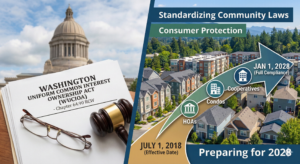
SB 5686 applies to every Washington common interest community covered by WUCIOA (RCW 64.90), including all communities formed on or after July 1, 2018 and pre-existing communities to the extent WUCIOA’s collection provisions apply to them as of January 1, 2026.
The mediation requirement is triggered by the same conditions that previously triggered WUCIOA non-judicial foreclosure: a member’s assessment delinquency that meets the statutory threshold for foreclosure action under RCW 64.90.485. The mediation step is positioned between the recorded lien and the foreclosure filing. Pre-2018 communities that have not opted into WUCIOA and continue to operate exclusively under RCW 64.38 or RCW 64.34 are likely not subject to SB 5686 directly; their foreclosure procedures continue under the prior statutory framework. (Verify with counsel for communities operating under layered statutory frameworks.) For the broader WUCIOA scope analysis, see the WUCIOA Washington HOA and condo board guide and the RCW 64.38 vs WUCIOA decision guide.
How does the SB 5686 mediation process work?
The SB 5686 mediation process follows a defined sequence triggered by the recorded assessment lien: written offer of mediation to the delinquent owner, statutory response window, mediator selection, mediation session, written outcome, and either resolution or eligibility to proceed to foreclosure.
The procedural timeline below summarizes the seven-step sequence boards should expect. Specific day-count requirements should be confirmed against the current SB 5686 statutory text before being written into association collection policy.
| Step | Action | Statutory anchor (verify) |
|---|---|---|
| Trigger | Assessment lien recorded under WUCIOA collection sequence | RCW 64.90.485 |
| Offer | Association serves written mediation offer on delinquent owner | SB 5686 notice provision (verify day-count) |
| Response | Owner accepts, declines, or fails to respond within statutory window | SB 5686 response window (verify) |
| Mediator selection | Mutually selected, drawn from approved roster, or per default mechanism | SB 5686 mediator-selection provision (verify) |
| Session | Mediation session held in person, remote, or hybrid | SB 5686 session-format provisions (verify) |
| Outcome | Written outcome documented (resolution, partial resolution, impasse) | SB 5686 outcome documentation (verify) |
| Foreclosure eligibility | If mediation resolves: foreclosure halted. If impasse or non-response after offer: foreclosure eligible. | SB 5686 + RCW 64.90.485 |
What does an SB 5686-compliant collection workflow look like?
An SB 5686-compliant collection workflow inserts the mediation offer, response window, and session into the existing WUCIOA collection sequence between lien recording and foreclosure filing, with documented evidence of each step retained in the association’s collection file.
The checklist below identifies the steps a Washington board (or its management company) should complete on every collection matter that progresses past the lien stage in 2026:
- Standard pre-lien collection sequence per RCW 64.90.485 (notice, demand, opportunity to cure)
- Lien recorded once statutory thresholds met
- New under SB 5686: Mediation offer served on delinquent owner with statutorily required content (verify content elements with counsel)
- New under SB 5686: Statutory response window observed before further action
- New under SB 5686: Mediator selected per statutory process, approved roster, or governing-document mechanism
- New under SB 5686: Mediation session held and outcome documented in writing
- Foreclosure eligibility confirmed (mediation impasse, owner non-response after offer, or written waiver from owner)
- Non-judicial foreclosure recorded per RCW 64.90 and RCW 61.24
Communities whose assessment delinquency volume justifies a written collection policy should rebuild that policy in early 2026 to reflect the new procedural step. Boards facing a structural delinquency problem driven by a special assessment should also review the HOA special assessments guide for payment-plan and notice procedures that may resolve delinquency before the lien stage triggers SB 5686 mediation.
What happens if a board skips the SB 5686 mediation requirement?
A non-judicial foreclosure recorded without the SB 5686 mediation step is procedurally defective and subject to challenge by the delinquent owner, with potential remedies including foreclosure reversal, statutory damages, and attorney’s fees liability under WUCIOA’s enforcement provisions.
The risk is concrete. A board that runs the 2024-era WUCIOA collection sequence (pre-foreclosure notice, lien recording, non-judicial foreclosure ninety days later) under 2026 rules is missing the mediation step that now sits between notice and foreclosure. Without a documented mediation offer in the record, the foreclosure is open to challenge regardless of how cleanly the rest of the collection cycle was executed.
Specific remedies and penalties depend on the final statutory text and how Washington courts interpret SB 5686 in early cases. The downside risk follows the same pattern that applies to other WUCIOA procedural failures: the underlying delinquency claim may survive the procedural challenge, but the association loses the foreclosure and may pay the homeowner’s legal fees in addition to its own. Communities should treat SB 5686 mediation as a non-optional procedural step in 2026 and beyond, even if the homeowner appears unlikely to participate.
When should a board involve counsel for SB 5686 mediation?
A board should involve counsel any time a delinquent assessment matter is about to enter the SB 5686 mediation phase, particularly for the first several mediation cycles after January 1, 2026 when statutory interpretation is still developing.
Routine assessment collections that resolve before lien recording rarely require counsel involvement on a per-matter basis. Collections that progress to the lien stage and beyond require the procedural discipline that SB 5686 demands. Self-managed boards in particular should plan for counsel review of the first three to five SB 5686 mediation cycles to lock in a defensible workflow, then move to counsel oversight only on the matters that escalate.
AMLO supports Washington HOA and condo boards through the WUCIOA collection sequence and is tracking SB 5686 interpretation as 2026 cases emerge. Reach out via the contact page to talk through your community’s current collection workflow and what needs to change before the next delinquency matter reaches the lien stage.
Frequently asked questions about SB 5686 Washington HOA foreclosure mediation
Does SB 5686 apply to my Washington condo association?
Yes, if your condominium association is governed by WUCIOA (RCW 64.90). This includes all condominiums formed on or after July 1, 2018 and pre-existing condominiums to the extent WUCIOA’s collection provisions apply to them under the staged 2026 effective dates. Condominiums formed before 1990 under RCW 64.32 that have not opted into WUCIOA may be outside SB 5686’s scope; verify with counsel.
Who pays for SB 5686 mediation?
The cost-allocation rules for SB 5686 mediation depend on the final statutory text and any implementing rules issued by Washington. Common cost-sharing approaches in analogous statutes include splitting mediator fees between the association and the homeowner, allocating cost to the prevailing party, or allocating to the party that requested mediation. Confirm the current SB 5686 cost-allocation rule with association counsel before serving the mediation offer.
What happens if the homeowner refuses to participate in SB 5686 mediation?
If the homeowner declines mediation in writing or fails to respond within the statutory response window, the association has satisfied the procedural offer requirement and may proceed to non-judicial foreclosure under RCW 64.90.485. The association’s collection file should document the offer, the delivery method, and the non-response or written decline before recording the foreclosure.
How long does the SB 5686 mediation process take?
From lien recording to foreclosure eligibility, the SB 5686 mediation process typically adds 30 to 90 days to the WUCIOA collection timeline depending on the specific statutory windows and the scheduling realities of mediator availability. Boards should plan for the mediation step to extend the historical lien-to-foreclosure window rather than fit inside it.
Can our board choose the mediator?
The mediator selection mechanism under SB 5686 is typically either mutual selection by the parties, selection from an approved statutory roster, or a default mechanism that applies if the parties cannot agree. The board cannot unilaterally choose the mediator over the homeowner’s objection. Confirm the current SB 5686 mediator-selection rule with counsel.
Is SB 5686 mediation binding?
The mediation session itself is non-binding in the sense that neither party is required to accept any specific proposal during the session. However, any written settlement signed by both parties at or after mediation is enforceable as a contract. The procedural requirement to offer and conduct mediation is mandatory; the outcome of the mediation is not.