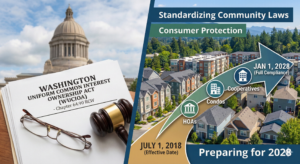
Washington HOAs are governed by one of two statutes depending on formation date: RCW 64.38 (the 1995 Homeowners Associations Act) for most communities formed before July 1, 2018, and WUCIOA (the 2018 Uniform Common Interest Ownership Act, codified as RCW 64.90) for all communities formed on or after that date, with WUCIOA progressively applying to pre-2018 communities through staged 2026 and 2028 effective dates.
What is the difference between RCW 64.38 and WUCIOA for Washington HOAs?
RCW 64.38 is Washington’s 1995 Homeowners’ Associations Act and currently governs most single-family HOAs formed in Washington before July 1, 2018.
WUCIOA (RCW 64.90), Washington’s 2018 Uniform Common Interest Ownership Act, is the successor statute that applies automatically to all common interest communities formed on or after that date and progressively applies to pre-existing RCW 64.38 communities through staged 2026 and 2028 effective dates. The two statutes differ in scope (HOAs only vs all CICs), member rights (limited statutory protection vs broad statutory rights), and procedural requirements (governing-document-driven vs statutory minimums).
The rest of this guide explains which statute governs your community today and what your board should do to prepare for the 2028 deadline.
If your homeowners association was formed before 2018, there is a good chance it has operated under RCW 64.38 (Washington’s Homeowners’ Associations Act) for most of its existence. It’s a relatively short statute, less detailed than most boards realize, and it has governed HOA life in Washington State for nearly three decades. Washington has more than 10,500 homeowners and condominium associations, most of them still operating under RCW 64.38 (SB 5129 impact statement, 2026).
That era is ending.
The Washington Uniform Common Interest Ownership Act, WUCIOA, codified as RCW 64.90, is replacing RCW 64.38 entirely. The transition deadline is January 1, 2028. Some requirements, including open meeting standards, are already in effect as of January 1, 2026. And the gap between what RCW 64.38 required and what WUCIOA now requires is significant: elections, reserve funds, financial reporting, enforcement procedures, owner rights, and much more.
This guide is for HOA board members who want a clear, side-by-side picture of what’s changing, what their board is already required to do right now, and how to position their community for a smooth transition before the deadline.
What Is RCW 64.38 and Who Does It Currently Cover?
RCW 64.38 (the Washington Homeowners’ Associations Act) was enacted in 1995.
It applies to homeowners associations that own or are responsible for maintaining common areas or enforcing restrictions on residential property in Washington State, and that were created before WUCIOA took effect in 2018.
At fewer than 40,000 words combined across all of Washington’s prior community association statutes, RCW 64.38 is a lean piece of legislation. It established baseline rules for HOA governance: assessment collection, lien rights, open records requirements, and meeting procedures. But it left enormous gaps that individual associations filled (sometimes inconsistently) through their own governing documents.
For communities formed under RCW 64.38, that statute has been the legal floor. Whatever your CC&Rs and bylaws said, as long as they didn’t violate RCW 64.38, they governed. The problem is that most pre-2018 governing documents reflect the standards of a different era, and many contain provisions that conflict directly with what WUCIOA now requires.
What Is WUCIOA and Why Does It Replace RCW 64.38?
WUCIOA (the Washington Uniform Common Interest Ownership Act, RCW 64.90) was first adopted in 2018 via SB 6175.
It is modeled on the Uniform Common Interest Ownership Act (UCIOA), a model statute developed by the Uniform Law Commission that has been adopted in various forms across multiple states.
The intent was to unify and modernize Washington’s fragmented approach to community association governance. Before WUCIOA, Washington communities were governed by three separate statutes depending on when and how they were formed: RCW 64.32 for older condominiums, RCW 64.34 for newer condos, and RCW 64.38 for HOAs. WUCIOA consolidates all of these into one unified framework.
At over 67,000 words and 120 sections as of early 2026, with major amendments via SB 5796 in 2024 and SB 5129 in 2025, WUCIOA is a fundamentally different kind of statute than RCW 64.38. Where RCW 64.38 set minimums, WUCIOA sets detailed standards. Where RCW 64.38 was largely silent, WUCIOA prescribes specific procedures.
What are the key differences between RCW 64.38 and WUCIOA side by side?
RCW 64.38 and WUCIOA differ across seven operational areas: board meetings and open-meeting rules, elections and secret ballots, reserve funds and reserve studies, financial reporting standards, rules and fine enforcement, owner rights and records access, and insurance requirements.
Board Meetings and Open Meeting Requirements
Under RCW 64.38, meeting requirements were relatively basic. Boards were required to hold meetings, provide notice, and keep minutes, but the statute gave associations considerable latitude in how they structured meeting procedures.
WUCIOA’s open meeting requirements, which took effect January 1, 2026, are far more specific. All board meetings must be open to unit owners. Owners have the right to speak at every meeting, before the board discusses or votes on any agenda item. Executive sessions are permitted but may only address a narrow list of topics defined by statute: pending litigation, personnel matters, delinquency collections, contract negotiations, and a few others. Meetings must be noticed at least 14 days in advance or on a formally published annual schedule. All materials provided to directors before a meeting must also be made available to owners before that meeting. Electronic meetings are allowed but must include a telephone dial-in option.
If your board has been holding meetings without following these standards, you are already operating outside the law. The January 1, 2026 deadline has passed.
For a step-by-step guide to running compliant board meetings under WUCIOA’s open meeting rules, see How to Run an HOA Board Meeting.
Elections and Secret Ballots
RCW 64.38 had limited election requirements. Many communities governed under it held elections through voice vote, show of hands, or other informal methods that their bylaws permitted.
WUCIOA mandates secret ballots for all board elections and for member votes on governing document amendments. The 2024 SB 5796 amendments added additional specificity: incumbent board members and candidates are prohibited from accessing ballots at any point before they are opened and counted at the meeting. Ballots must be counted at the meeting called for that purpose. Associations must take reasonable measures to verify voter identity for electronic participation. Voting rights cannot be suspended under any circumstances, even for delinquent owners. Election notices must disclose the number of open positions, qualification requirements, and the nomination process.
Many boards transitioning from RCW 64.38 are surprised by how prescriptive WUCIOA’s election procedures are. An election conducted under your old bylaws, even if those bylaws have been followed for years, may not satisfy WUCIOA’s requirements.
Reserve Funds and Reserve Studies
RCW 64.38 required associations to maintain reserve accounts but was relatively sparse on specifics. Many communities operated with minimal reserve study discipline, inconsistent funding practices, and governing documents that gave boards broad discretion over reserve management.
WUCIOA codifies reserve governance in precise terms. The board must maintain direct control over all reserve funds. Reserve studies must be updated annually (not every three years, as was common practice under prior law). Studies must include all components whose replacement cost exceeds 1% of the annual budget. Studies must express reserve surplus or deficit on a per-unit basis. Transfers out of reserve accounts require two signatures and detailed supporting documentation. Reserve funds may now be invested, subject to specific statutory criteria. Budgets must disclose any planned reserve borrowing.
For many communities, meeting WUCIOA’s reserve study requirements will mean contracting with a qualified reserve specialist if they haven’t already, and potentially revising how reserve accounts are structured and managed. See our HOA Reserve Fund 101 guide for what a compliant study looks like under current Washington law.
Financial Reporting and Accounting Standards
RCW 64.38 required financial records to be maintained and made available to members but did not specify accounting methodology.
WUCIOA requires all community associations to use accrual-based accounting. Annual audits are required and cannot be waived by member vote, with an exception for associations with annual budgets under $50,000. All dollar thresholds in the statute adjust with inflation over time.
Associations that have been using cash-basis accounting (common among smaller HOAs) will need to transition to accrual-basis accounting before the 2028 deadline. This typically requires working with a CPA familiar with community association accounting. Our guide to building an HOA budget covers accrual-basis basics and what your annual financials should include.
Rules, Fines, and Enforcement
Under RCW 64.38, the framework for rules and enforcement was largely left to individual governing documents. Many communities have fine schedules and enforcement procedures embedded in their CC&Rs or bylaws that were drafted without a consistent statutory model.
WUCIOA establishes a mandatory double-notice process for creating, amending, or repealing any rule. A formal fine schedule must exist and be properly noticed before any fines can be imposed. Creating or changing a fine schedule requires the same double-notice process as rule changes. The board has explicit discretion to stay enforcement, but enforcement must remain consistent: arbitrary or selective enforcement is prohibited.
Fines imposed without following WUCIOA’s required process are unenforceable. Communities that transition to WUCIOA without updating their enforcement procedures risk having fine actions successfully challenged by owners.
Owner Rights and Records Access
RCW 64.38 provided owners the right to inspect association records but was not highly specific about timelines or scope.
WUCIOA significantly expands owner rights. Records disclosures must be provided within 10 days of a written request (21 days maximum in certain circumstances). Owners may opt their email addresses out of records disclosures. Political signs may not be banned; only reasonable rules on size and placement are permissible. Owners may formally request that the board evaluate and remove unlawful restrictions from governing documents. Associations must accept at least one form of assessment payment at no charge to the owner.
Insurance Requirements
RCW 64.38 had limited insurance requirements. Most communities relied on their declarations to define master policy obligations.
Under WUCIOA, master property insurance must cover units, and unless the declaration explicitly states otherwise, must also cover all improvements and betterments made to units by owners. This is a meaningful departure from prior law that may require communities to update their insurance policies and, in many cases, their declarations to explicitly address unit improvement coverage.
What WUCIOA compliance deadlines apply to Washington HOAs right now?
The transition is not all-or-nothing on January 1, 2028.
Some WUCIOA requirements are already in effect for all Washington community associations.
January 1, 2026: Open Meeting Requirements
Open meeting standards under RCW 64.90.445 now apply to all Washington community associations regardless of when they were formed or which prior statute governed them. If your board has not yet implemented compliant open meeting practices, you are operating outside the law today.
January 1, 2028: Full WUCIOA Compliance
All residential community associations in Washington State must be in full compliance with RCW 64.90 by this date. Pre-existing communities governed by RCW 64.38 must transition entirely to WUCIOA standards. Non-compliant provisions in your governing documents become legally unenforceable. Board members who knowingly act contrary to WUCIOA requirements can face personal liability.
What should a Washington board do in 2026 vs 2027 vs 2028?
A Washington board working the WUCIOA transition on a sensible calendar should treat 2026 as the open-meeting compliance year, 2027 as the governing-document and reserve-study restatement year, and 2028 as the full WUCIOA applicability year, with each step setting up the next without compression at the deadline.
In 2026, the open-meeting requirements under RCW 64.90.445 are already in effect for all Washington community associations regardless of formation date. Boards should audit meeting notice cadence (14 days minimum), agenda distribution, executive session topic discipline, and member-comment procedures against the WUCIOA standard. The single highest-impact deliverable for 2026 is a revised meeting-notice template that complies with WUCIOA, distributed with every meeting notice from the start of the year forward.
In 2027, the focus shifts to governing-document review and reserve-study restatement. Boards should commission a CC&R-and-bylaws conflict analysis against WUCIOA (which provisions in the existing documents become unenforceable when WUCIOA fully applies in 2028), bring the reserve study into the WUCIOA disclosure format, and draft a WUCIOA-compliant reserve-funding policy. Both deliverables should land in time for the annual budget package distribution at the close of 2027 so the 2028 fiscal year opens with WUCIOA-compliant documents in member hands. For the reserve-study side of this work, see HOA Reserve Fund 101: What It Is, How It Works, and Why It Matters, which covers the WUCIOA reserve-study disclosure format and the 2026/2028 phase-in implications for reserve work specifically.
In 2028, the substantive WUCIOA provisions apply across the board. Boards arriving at January 1, 2028 with the 2026 open-meeting work and the 2027 governing-document and reserve-study work already complete face a manageable cutover; boards that compress the transition into late 2027 face a much higher risk of disclosure defects in the first WUCIOA-compliant budget package. The full applicability date is fixed; the 2026 and 2027 preparatory work is the operational lever boards control.
What documents need to be updated as part of the WUCIOA transition?
The four documents every Washington HOA board should plan to revise during the RCW 64.38 to WUCIOA transition are the meeting-notice template, the CC&R/bylaws restatement, the reserve study and reserve-funding policy, and the annual budget summary including the reserve-disclosure section.
The meeting-notice template is the lightest lift and the most time-sensitive (already required in 2026). The CC&R and bylaws restatement is the heaviest lift and warrants counsel review, because pre-2018 governing documents typically contain provisions that conflict with WUCIOA at multiple points (election procedures, member-vote thresholds, executive-session topics, fine-enforcement sequences). The reserve study and reserve-funding policy follow the WUCIOA disclosure format starting in the 2026 study cycle. The annual budget summary brings together the funding-policy disclosure, the reserve analysis, and the funding-gap statement that WUCIOA requires.
The companion 2026 amendment SB 5686 adds pre-foreclosure mediation requirements that affect the collection backstop on delinquent assessments, which boards should review alongside the budget-summary work so that the assessment-collection sequence in 2028 reflects both WUCIOA and SB 5686.
How should a Washington board choose between staying under RCW 64.38 and opting into WUCIOA early?
A Washington community formed before July 1, 2018 cannot stay under RCW 64.38 indefinitely; WUCIOA’s substantive provisions apply to all pre-2018 communities by January 1, 2028 regardless of board preference, so the practical question is whether to opt into WUCIOA early or run the staged 2026 to 2028 transition.
Early opt-in via member vote under RCW 64.90.080 is appropriate for communities where (1) the existing governing documents are already substantively aligned with WUCIOA (uncommon for pre-2010 documents), (2) the board values predictability and wants to operate under a single statutory regime rather than the dual RCW 64.38 plus phasing-in WUCIOA structure, or (3) a near-term governance decision benefits from operating under WUCIOA’s expanded member-rights framework. Most pre-2018 communities elect to ride the staged transition rather than vote to opt in early, because the member-approval threshold for opt-in is itself a governance project that competes for board capacity with the substantive transition work.
Washington boards weighing the opt-in question, the 2026 to 2028 transition cadence, or any of the document restatement work benefit from a management partner with deep WUCIOA experience. AMLO serves Washington HOA and condominium boards with a WUCIOA-anchored transition workflow that maps the operational milestones to the statutory deadlines so the cutover lands without compression.
Why are governing document restatements essential for Washington HOAs before 2028?
One of the most consequential implications of the RCW 64.38 to WUCIOA transition is its effect on your existing governing documents.
When WUCIOA applies to your community and your governing documents conflict with the statute, the statute wins automatically. A provision in your CC&Rs or bylaws that contradicts WUCIOA becomes legally unenforceable on January 1, 2028, whether or not you’ve amended it.
This creates a real governance problem. Operating with governing documents that are partially unenforceable produces ambiguity for board members, confusion for owners, and legal exposure for the association. The clean solution is a governing document restatement: an amendment and restatement that produces a single, updated version of your declaration and bylaws consistent with RCW 64.90 and your community’s current reality.
Adopting RCW 64.90 through a restatement requires a 67% affirmative vote of members. That supermajority threshold is not easy to achieve, and the process (drafting, legal review, owner communication, meeting, ballot, counting) takes time. Communities that begin the restatement process in 2027 will likely run out of time.
The boards that navigate this transition most successfully are the ones that start now: assessing where their governing documents conflict with WUCIOA, engaging an attorney familiar with Washington community association law, building an owner communication plan, and scheduling the restatement process with enough runway to achieve the required vote.
What does a WUCIOA compliance checklist look like for Washington HOA boards?
A WUCIOA compliance checklist covers three phases of work: open meeting compliance required as of January 1, 2026, governance and reserve-study compliance phasing in through 2027, and full WUCIOA applicability triggered January 1, 2028 for all pre-existing covered communities.
Open Meeting Compliance (required as of January 1, 2026)
- Board meetings open to all owners
- Owners permitted to speak before board discussion or votes on any agenda item
- Executive sessions limited to statutorily permitted topics
- 14-day advance meeting notice or published annual schedule
- Meeting materials made available to owners before each meeting
- Electronic meetings include a telephone dial-in option
Election Procedures
- Secret ballots for all board elections and governing document amendment votes
- Candidates and incumbents excluded from ballot access before counting
- Ballots counted at the meeting
- Voter identity verification process for electronic participation
- Voting rights not suspended under any circumstances
Reserve Fund Management
- Annual reserve study updates (not every three years)
- Board maintains direct control of all reserve funds
- Two-signature requirement for reserve transfers with supporting documentation
- Per-unit reserve surplus or deficit disclosed in budget
- Reserve investment policy adopted if applicable
Financial Reporting
- Transition to accrual-based accounting completed
- Annual audit coordinated (exception: budgets under $50,000)
- Inflation-adjusted dollar thresholds monitored annually
Rules and Enforcement
- Double-notice process documented and followed for all rule changes
- Formal fine schedule properly noticed before any fines are imposed
- Consistent enforcement standards documented and applied
Governing Document Restatement
- Attorney-led assessment of conflicts between existing documents and RCW 64.90
- Restatement drafted with legal counsel
- Owner communication plan developed
- 67% member vote secured before 2028 deadline
Insurance Review
- Master policy reviewed for unit coverage and improvements/betterments coverage consistent with WUCIOA requirements
Frequently Asked Questions: WUCIOA and the RCW 64.38 Transition
Does WUCIOA apply to my HOA if it was formed before 2018?
Yes. The January 1, 2028 deadline applies to all Washington community associations, including those formed before WUCIOA took effect. Communities formed under RCW 64.38 are not grandfathered out of WUCIOA; they must comply in full by 2028. Several provisions, including open meeting requirements, already apply to all associations as of January 1, 2026.
What happens if our governing documents conflict with WUCIOA after 2028?
The statute controls. Any provision in your CC&Rs or bylaws that conflicts with RCW 64.90 becomes legally unenforceable when WUCIOA applies to your community. Your documents don’t need to be amended for WUCIOA to take effect, but operating with unenforceable provisions creates governance ambiguity and legal exposure. A governing document restatement eliminates that risk.
Can voting rights be suspended for delinquent owners under WUCIOA?
No. WUCIOA explicitly prohibits the suspension of voting rights under any circumstances, including assessment delinquency. This is a direct departure from practices many communities developed under RCW 64.38. If your current governing documents permit voting right suspension, those provisions are unenforceable under WUCIOA.
What vote is required to adopt WUCIOA through a governing document restatement?
A 67% affirmative vote of all members is required. This is not a simple majority. The drafting, legal review, owner communication, and ballot process typically takes six to twelve months. Starting in 2027 is too late for most communities.
Does WUCIOA apply to condominiums as well as HOAs?
Yes. One of WUCIOA’s primary purposes was to consolidate Washington’s three separate community association statutes (RCW 64.32 for older condos, RCW 64.34 for newer condos, RCW 64.38 for HOAs) into one unified framework. WUCIOA applies to both condominium associations and homeowners associations.
What did the 2024 and 2025 WUCIOA amendments change?
The 2024 SB 5796 amendments added significant specificity to election procedures, including the explicit prohibition on candidate and incumbent ballot access before counting. The 2025 SB 5129 amendments made additional changes to the statute. (Washington HOA boards should consult with a qualified community association attorney for a full accounting of recent amendments, as legislative changes may affect specific compliance obligations.)
Which statute governs your Washington community?
Applicability decision table by formation date and community type
The table below answers the practical question every Washington board is asking right now: which statute governs us, and when does that change.
| Community profile | Currently governed by | WUCIOA effect |
|---|---|---|
| HOA formed on or after July 1, 2018 | WUCIOA (RCW 64.90) | Full WUCIOA from creation; RCW 64.38 does not apply |
| HOA formed under RCW 64.38, before July 1, 2018 | RCW 64.38 today; WUCIOA overlay phasing in | Open meeting rules apply January 1, 2026; full WUCIOA by January 1, 2028 |
| Condominium formed on or after July 1, 2018 | WUCIOA (RCW 64.90) | Full WUCIOA from creation; RCW 64.34 does not apply |
| Condominium formed under RCW 64.34, between July 1, 1990 and July 1, 2018 | RCW 64.34 today; WUCIOA overlay phasing in | Open meeting rules apply January 1, 2026; full WUCIOA by January 1, 2028 |
| Condominium formed before July 1, 1990 (HPRA, RCW 64.32) | RCW 64.32 today; limited WUCIOA application | Most procedural obligations remain with RCW 64.32 and recorded declaration |
| Any community that has opted into WUCIOA | WUCIOA in full from opt-in effective date | RCW 64.38, 64.34, or 64.32 no longer apply once opt-in is recorded |
For the underlying statute walkthrough, see the WUCIOA Washington HOA and condo board guide. Boards preparing for the 2028 deadline should also review the reserve fund 101 guide, because WUCIOA’s reserve-study requirements are among the most material upgrades over RCW 64.38.
WUCIOA effective-date timeline for RCW 64.38 communities
If your community currently operates under RCW 64.38, the timeline below identifies the specific dates on which WUCIOA’s provisions become applicable to your board’s operations.
| Date | What applies | Practical board impact |
|---|---|---|
| Currently | RCW 64.38 governs; WUCIOA does not apply unless opted in | Open meeting rules and member rights follow governing documents |
| January 1, 2026 | WUCIOA open meeting, election, and member-rights provisions apply | Rebuild meeting notice and member-attendance practices to meet RCW 64.90.445 |
| 2026–2027 (preparation window) | Communities prepare for full applicability | Reserve study, financial reporting, and governing document restatement work |
| January 1, 2028 | Full WUCIOA applicability for all pre-existing communities | Governing documents, reserve study, financial reporting, and enforcement procedures must align with RCW 64.90 |
Boards facing a special assessment to fund reserve gaps before 2028 should review the special assessments guide for the threshold rules and member-notice procedures that apply during the transition. Self-managed boards rebuilding meeting practices for the January 1, 2026 open meeting effective date should also review the how to run an HOA board meeting guide.
Additional questions about RCW 64.38 and WUCIOA
Does WUCIOA replace RCW 64.38?
WUCIOA does not formally repeal RCW 64.38. RCW 64.38 continues to apply to single-family HOAs formed before July 1, 2018 until WUCIOA’s staged effective dates take over (open meeting rules January 1, 2026; full applicability January 1, 2028).
Can a Washington HOA stay under RCW 64.38?
No. Beginning January 1, 2028, WUCIOA’s substantive provisions apply to all pre-existing Washington community associations regardless of when they were formed. A community cannot remain exclusively under RCW 64.38 after the 2028 deadline. The choice boards face is whether to opt in early through a governing-document restatement or wait for statutory applicability to take effect.
What is the biggest practical difference between RCW 64.38 and WUCIOA?
The biggest practical difference is statutory enforceability of member rights. RCW 64.38 leaves most procedural matters (meeting notice, document inspection, election procedure, rule enforcement) to governing documents. WUCIOA establishes statutory minimums for each of those areas under RCW 64.90. Boards accustomed to operating under their own bylaws will find WUCIOA more prescriptive and less customizable.
Does a pre-1990 HPRA condo association have to follow WUCIOA?
Pre-1990 condominium associations formed under the Horizontal Property Regimes Act (RCW 64.32) have the most limited WUCIOA exposure. The original RCW 64.32 statute and the recorded declaration continue to govern most operational questions. WUCIOA’s open meeting and member-rights provisions effective January 1, 2026 apply selectively to RCW 64.32 communities.
Can a Washington HOA opt into WUCIOA early?
Yes. RCW 64.90.080 permits a pre-2018 community to opt into WUCIOA by amending its governing documents through the statutory amendment vote, typically 67% affirmative member approval. Many communities preparing for 2028 use the opt-in to start applying WUCIOA procedure on a fixed schedule rather than waiting for the statutory deadline.
How AmLo Management Supports the WUCIOA Transition
WUCIOA compliance is not a one-time task.
It shapes every meeting, every vote, every financial decision, and every owner communication your board makes. The transition from RCW 64.38 requires operational changes across meeting management, election administration, financial reporting, reserve oversight, and enforcement procedures.
AmLo Management was built to help Washington State HOA boards operate correctly in this environment. Our WUCIOA compliance services include:
- Board meeting management with proper notice and open meeting procedures
- Secret ballot election administration
- Annual reserve study coordination
- Accrual-basis financial management and audit coordination
- Compliant rules and fine schedule drafting
- Owner communications handled on every statutory timeline
We stay current with every change to RCW 64.90. When the legislature amends WUCIOA (and it has, significantly, in both 2024 and 2025) our clients find out immediately and understand exactly what it means for their community.
If your community is governed by RCW 64.38 and you haven’t yet begun planning for the 2028 transition, the time to start is now. The 67% vote required for a governing document restatement leaves no room for a last-minute approach.
Contact AmLo Management to learn how we help Washington HOA boards move from RCW 64.38 to full WUCIOA compliance, on time, and without the liability exposure that comes from getting it wrong.
Disclaimer: This post is provided for general informational purposes only and does not constitute legal advice. Washington HOA boards should consult with qualified legal counsel regarding their specific WUCIOA compliance obligations. Information reflects the law as understood in early 2026; subsequent legislative changes may affect accuracy.